Get Full Government Meeting Transcripts, Videos, & Alerts Forever!
Get email alerts on the Transportation And Infrastructure topic
No spam. Unsubscribe anytime.
Planning staff outlines EPIC impact‑fee programming and $260 million collection expectation
Summary
Planning staff presented the EPIC/YIPIC implementation report, projecting roughly $260 million in impact‑fee receipts this fiscal year across six area plans, with notable funding gaps such as an estimated $108 million shortfall in Eastern Neighborhoods.
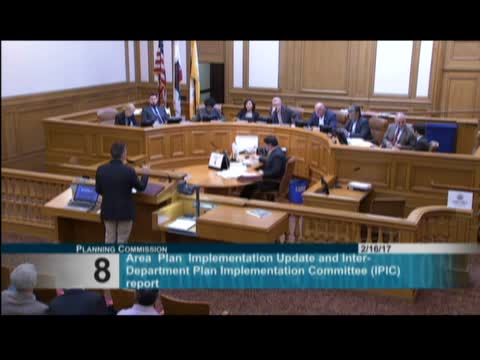
San Francisco — The Planning Commission heard an annual implementation update on the EPIC (implementation plan) process and YIPIC inter‑agency committee that programs area‑plan infrastructure using impact fees.
Matt Snyder, who leads the implementation team, explained EPIC’s role in programming impact‑fee revenue across six plan areas (Eastern Neighborhoods, Market Octavia, Rincon Hill, Transit Center, Balboa Park, Visitation Valley). Snyder said the city expects to collect roughly $260 million in impact fees during the current fiscal year and anticipates about $165 million in the FY18–FY22 five‑year cycle (estimates sensitive to transit‑center project timing).
Snyder described how EPIC and community advisory committees (CACs) prioritize categories such as transit, complete streets, recreation/open space and childcare. He reported programming highlights: Market Octavia expects roughly $26.3M collected this year; Eastern Neighborhoods expects ~$77.9M this year and a multi‑year total of about $161M; identified funding gaps remain (Eastern Neighborhoods gap ~ $108M under original plan assumptions). Snyder also noted a $5.5M contribution from Eastern Neighborhoods fees toward Garfield Aquatic Center rehabilitation.
Commissioners asked about indexing to construction costs, fund delivery and how projects are prioritized against changing revenue forecasts. Snyder said the fee index is partially construction‑cost‑based and that EPIC will continue iterative programming with agency partners and CACs.
Why it matters: Impact fees are a principal local tool to fund public‑realm improvements tied to area plans; commissioners flagged large funding gaps and asked for clarity on delivery and coordination with other funding sources.