Get Full Government Meeting Transcripts, Videos, & Alerts Forever!
Get email alerts on the Latino Cultural District topic
No spam. Unsubscribe anytime.
Planning Commission Recommends Latino Cultural District Special Use District to Board After Heated Public Hearing
Summary
After hours of testimony for and against the Calle 20/4 Latino Cultural District special use district, the Planning Commission voted to recommend approval to the Board of Supervisors with an amendment exempting limited‑restaurant→full‑restaurant conversions from the concentration control; staff and the mayor’s office framed the SUD as a modest, experimental tool to stabilize small storefronts and legacy businesses.
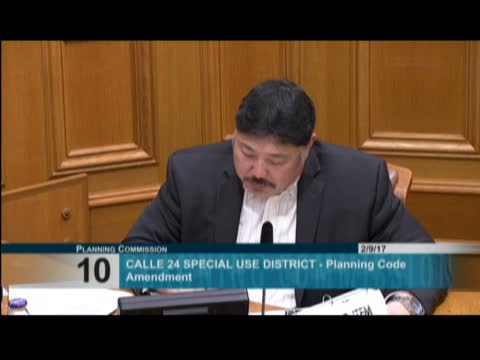
The Planning Commission voted Feb. 9 to recommend approval of a proposed Calle 20/4 Latino Cultural District Special Use District (SUD) for the Lower 20th/Valencia corridor, sending the measure to the Board of Supervisors with a staff amendment to exempt conversions from ‘‘limited restaurant’’ to full eating‑and‑drinking establishments from the eating‑and‑drinking concentration control.
The proposal — introduced by Supervisor Hillary Ronan’s office and shepherded by the Planning Department and the Office of Economic and Workforce Development — would establish a corridor overlay that: caps eating‑and‑drinking establishments at 35% concentration along the corridor (higher than the 25% threshold applied in some other districts), triggers conditional use authorization for three additional changes (storefront mergers, replacement of legacy‑business sites, and certain medical services), and adds six purpose‑findings for conditional‑use reviews (for example, supporting arts and preserving legacy‑business contributions). Under the SUD businesses subject to a conditional‑use review would need to meet several of the purpose findings to proceed, and the proposal relies on other city agencies (OEWD, mayor’s office) to help implement workforce and small‑business supports.
Public testimony was large and sharply divided. Supporters — merchants, neighborhood cultural organizations, legacy business owners, arts groups and immigrant‑advocacy organizations — said the modest zoning tools are necessary to slow the loss of small storefronts and to preserve cultural institutions and affordable studio space. Opponents argued the SUD could be legally fraught and exclusionary, could raise costs or barriers for prospective small businesses, and might not address the real drivers of displacement (regional housing shortages and rent pressures). Several speakers asked for stronger, enforceable financial supports (commercial‑rent support, right of first refusal, longer‑term land‑use tools) beyond zoning.
Commissioners debated practical enforcement questions — how staff would detect same‑use changes (tenant‑to‑tenant swap), how the concentration threshold would be measured, and whether the Commission should provide interpretive guidance while the SUD remains under observation. Commissioner Johnson pressed staff to record specific recommendations to send to the Board of Supervisors; Commissioner Melgar acknowledged the SUD is “experimental” and supported a five‑year review requirement to assess effectiveness. The Commission adopted the recommendation to the Board unanimously (6–0).
The measure will now move to the Board of Supervisors for the legislative steps required to enact a special use district.