Get Full Government Meeting Transcripts, Videos, & Alerts Forever!
Get email alerts on the Land Use topic
No spam. Unsubscribe anytime.
Neighbors press Planning Commission to favor mid‑rise alternative in Central SoMa Draft EIR
Summary
Residents, neighborhood groups and some commissioners urged the Planning Commission to favor a reduced‑height (mid‑rise) alternative in the Central SoMa Draft Environmental Impact Report, citing displacement risks, childcare shortages and a jobs‑housing imbalance. Staff said the Draft EIR analyzes multiple alternatives and is open for written comments through Feb. 13, 2017.
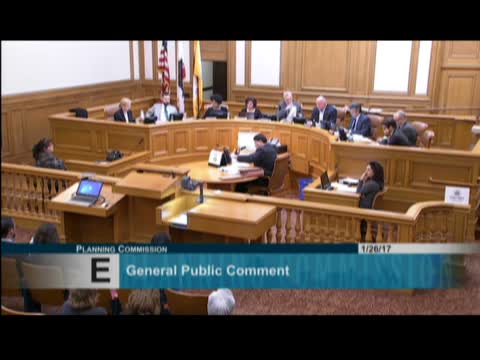
The Planning Commission on Jan. 26 opened a public hearing on the Central South Of Market (Central SoMa) Draft Environmental Impact Report, hearing sustained public opposition to the plan’s higher‑rise alternative and requests to prefer a reduced‑height option.
Planning staff framed the Draft EIR as a citywide planning tool that would rezone roughly 230 acres and 17 blocks to encourage housing and jobs growth near the Central Subway. Michael Jacinto, planning staff, said the EIR analyzes land‑use, transportation, air quality and alternatives that include a “no project,” reduced‑height (mid‑rise), and higher‑rise scenario. He said the Draft EIR finds some significant impacts that cannot be fully mitigated and lays out five alternatives for decision‑makers and the public to compare.
Public speakers arriving for the hearing urged the commission to direct staff to prefer the reduced‑height option. Richard Drury, representing Central SoMa Neighbors and SF Blue, told commissioners the mid‑rise alternative would retain neighborhood scale and deliver nearly as much housing and job growth while avoiding the “Manhattanization” of SoMa. “The mid‑rise alternative would allow approximately 90% of the job growth and housing growth as the high‑rise alternative, but maintain a livable, family‑friendly community at a pedestrian scale,” he said.
Others pressed the department on gaps in the EIR’s analysis. Tenants’ and neighborhood advocates asked for a deeper study of displacement risks, an income‑level breakdown of the jobs the plan would create, and an assessment of how much family‑friendly housing the alternatives would generate. Several speakers, including preservation and childcare advocates, said the Draft EIR lacks adequate public‑services analysis for schools, childcare and street‑level services given projected household and employment growth.
Commissioners thanked speakers and asked staff for written follow‑up on technical questions. Commissioner Johnson called the EIR “special for us” and said he would submit written comments on transit and public facilities; Commissioner Richards and others flagged the plan’s jobs‑housing imbalance and asked for additional analysis of where new workers will live. Planning staff reminded the public that written comments on the Draft EIR will be accepted through 5 p.m. on Feb. 13, 2017, and that responses to comments will be published as part of the final environmental review.
The commission did not take a final vote on the plan at the hearing; the Draft EIR remains on public review and staff will return responses to the commission as required by CEQA.