Get Full Government Meeting Transcripts, Videos, & Alerts Forever!
Get email alerts on the 100 Mission Trees topic
No spam. Unsubscribe anytime.
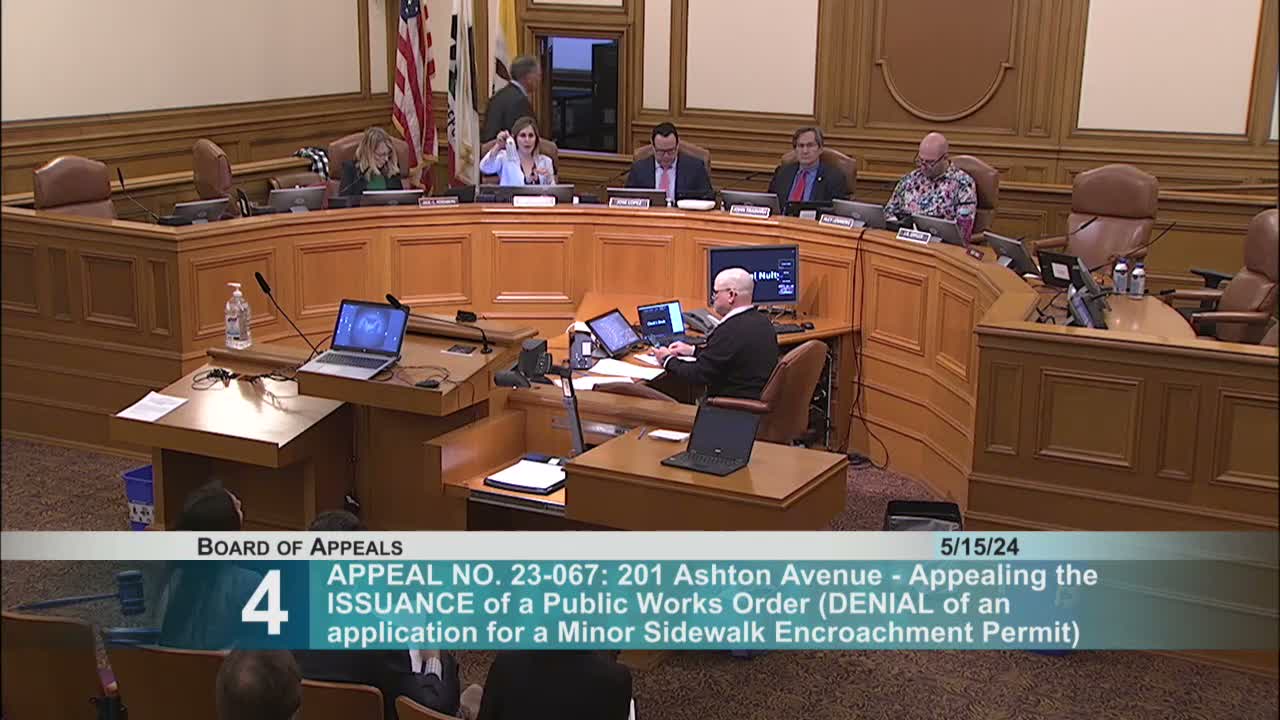
Downtown waterproofing plan pits building owner against tree advocates; Board asks for more analysis and continues matter
Summary
A developer’s request to remove 10 street trees near 100 Mission/60 Spear for basement waterproofing — with a plan to replant eight trees in larger boxes — sparked wide public protest; the Bureau of Urban Forestry and commissioners asked for appraisal/basal-area data, the MTA to clarify a signal-box constraint and for BUF/DPW to produce development-versus-maintenance analysis before the continued hearing.
Appellants and the Bureau of Urban Forestry presented competing accounts of whether 10 mature street trees should be removed to allow a monolithic waterproofing membrane under sidewalk tree wells at 100 Mission and 60 Spear. The property owner’s counsel said structural engineers recommend removing trees to access and permanently waterproof the structure that forms the basement roof beneath the sidewalk; the owner proposed replacing eight trees on-site (two tree wells constrained by Muni signal equipment cannot accept replacements) and increasing tree-box sizes from 24 to 36 inches where possible.
Nicholas Crawford, acting superintendent of the Bureau of Urban Forestry, said inspectors had originally approved the removal at staff level, the hearing officer denied the removal on protest, and BUF has since negotiated larger replacement sizes with the owner. Crawford described technical limits of tree-planter boxes in the downtown planting strip and said some planters are effectively containerized (root-limited) and that 36-inch boxes are the most practicable replacement on site. He also said DPW is asking MTA whether signal infrastructure could be relocated to preserve a planting site.
Commissioners pressed BUF on whether a 1:1 replacement is adequate for mature trees or if a basal-area or appraisal-based replacement should apply. BUF noted the minor-encroachment/permit code generally requires 1:1 replacement for construction-permit-driven removals but acknowledged the climate-action basal-area approach and appraisals have been applied in other development cases. BUF provided an in-lieu fee figure in the record of $2,431 per tree for cases where planting on-site is infeasible and agreed to provide basal-area metrics and an appraisal estimate for the existing trees ahead of the continued hearing.
Public testimony included strong opposition from neighborhood groups and tree advocates, who argued the hearing officer’s earlier denial should stand without reversal and criticized the perceived weakness of the in-lieu fee. The Board asked BUF and DPW to (a) provide a basal-area replacement calculation or appraisal estimate for the trees, (b) share the department’s development-versus-maintenance checklist and rationale, and (c) pursue a definitive response from MTA about relocating signal infrastructure. The Board continued the matter to June 26, 2024 to allow those materials and limited briefs to be supplied.
Next steps: BUF/DPW to submit the requested valuation and checklist materials, and to report back on MTA's response prior to the continued hearing.