Get Full Government Meeting Transcripts, Videos, & Alerts Forever!
Get email alerts on the Planning Policy topic
No spam. Unsubscribe anytime.
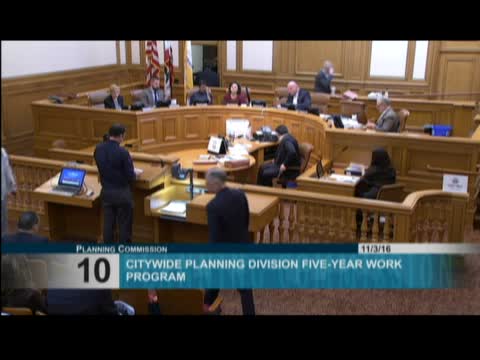
Citywide Planning Division outlines five-year work program, stresses equity and scenario planning
Summary
Planning staff presented a midpoint update to the Citywide Division's 2014-2019 work program, centering on equity, housing, Connect SF, resilient waterfronts and neighborhood strategies; commissioners pressed for clearer neighborhood-plan mechanics, staffing and contingency scenarios.
The Planning Department's Citywide Division presented a midterm update to its five-year work program, describing priorities and new initiatives intended to guide the city's long-range planning through 2019.
Acting director Adam Barrett told the commission the work program frames the division's priorities around five strategic directions: equity and opportunity, resilience and sustainability, transportation connections, appealing public spaces and inclusive civic processes. "The first priority is working towards a more equitable, affordable, and diverse city," Barrett said, characterizing deliverables such as the Mission Action Plan and an Affordable Housing Strategy.
Barrett also described new, topic-based practice groups including Advancing Community Equity and Housing for All, and reiterated a multiagency Connect SF effort to create a long-range transportation vision. "Scenario planning is part of how we improve long-term foresight," Peter Albert, a division manager, added, explaining the division's work with a futurist to test alternative scenarios for transportation and urban change.
Public commenters and commissioners pushed staff on policy gaps. Tom Radulovich of Livable City urged the department to prepare an explicit land-use element for the General Plan and to revive neighborhood planning that pairs land use with stabilization strategies to limit displacement. "San Francisco has no land-use element in its General Plan," he said, urging a coherent narrative that connects zoning, climate resilience and equity.
Commissioners debated trade-offs between citywide, issue-based initiatives and older neighborhood-plan models. Several members stressed the need to connect planning outcomes to operational agencies (rec and parks, Muni, schools) and to provide clearer contingency or iteration mechanisms when rapid market changes occur (short time horizons, sharing economy, TNCs). Staff said the work program is intended to inform biennial budget requests and to guide resource allocation across multiple ongoing projects.
No formal vote was required; commissioners asked staff for follow-up briefings and additional detail on staffing, budget phasing and how the scenario work will translate into operational recommendations.