Get Full Government Meeting Transcripts, Videos, & Alerts Forever!
Get email alerts on the Medical Cannabis topic
No spam. Unsubscribe anytime.
Planning Commission rejects proposed medical cannabis dispensary at 100 Sickles Avenue, citing clustering and neighborhood impact
Summary
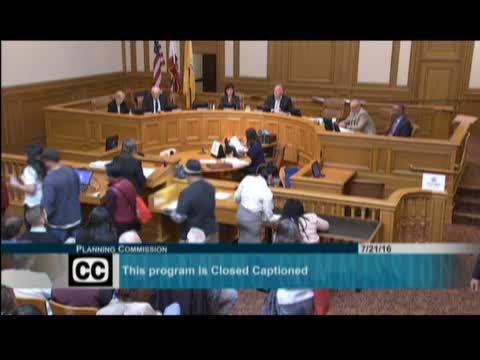
The Planning Commission voted unanimously July 21 to disapprove a mandatory discretionary review for 'Green God's Compassion' at 100 Sickles Avenue after a large public turnout and testimony from public safety officials and numerous neighbors citing clustering, parking, and proximity to schools and youth services.
SAN FRANCISCO — The San Francisco Planning Commission voted 6–0 on July 21 to disapprove a mandatory discretionary review for a proposed medical cannabis dispensary, Green God’s Compassion (GGC), at 100 Sickles Avenue in the Outer Mission / Excelsior neighborhood.
Planning Department staff recommended the commission take discretionary review and approve the project for location and physical characteristics, noting the site met code distances to schools and that the sponsor had submitted a safety and security plan. The department’s report said the applicant had undertaken community outreach and proposed a mix of products, no on‑site smoking, delivery service, hours of operation from 9 a.m.–8 p.m. on weekdays and 10 a.m.–8 p.m. on weekends, and a plan to provide security and lighting.
But the hearing featured a large number of neighborhood residents and community groups who urged denial, and local public safety officials expressed concern about saturation. "The problem is not necessarily what's been offered here, but the clustering, which is what we really need to focus on within my district," said Captain Joe McFadden of Ingleside Station, testifying that clustering in District 11 had led to increased calls for service, loitering, double parking and other quality‑of‑life complaints.
Jeremy Pollack read a letter from Supervisor John Avalos opposing the application. Opponents argued that District 11 already has multiple medical cannabis facilities within a short radius, that sickles is a high‑pedestrian corridor used by children and seniors and that additional dispensaries produce parking and security impacts.
The project sponsor, Takisha Upshaw Ong, described GGC as a purpose‑built wellness center targeting seniors and veterans and emphasized education, referral services and delivery. “GGC will be a lit well lit retail only wellness center with seating for patients to confer with staff,” she said, adding the operation would prioritize security, delivery and a neighbor task force to address any problems.
Commissioners debated the competing factors: staff’s finding of technical code compliance for this location versus the broad, sustained neighborhood opposition and public‑safety testimony about clustering. Several commissioners said the clustering and saturation pattern in District 11 weighed heavily. Commissioner Richards moved to take discretionary review and disapprove the project; the motion carried unanimously with Commissioners Antonini, Johnson, Moore, Wu, Richards and President Fong voting aye.
Staff noted the applicant could return with a new application at the site in the future; department staff indicated a returning application would typically be eligible after one year.