Get Full Government Meeting Transcripts, Videos, & Alerts Forever!
Get email alerts on the 1066 Market 101 Hyde topic
No spam. Unsubscribe anytime.
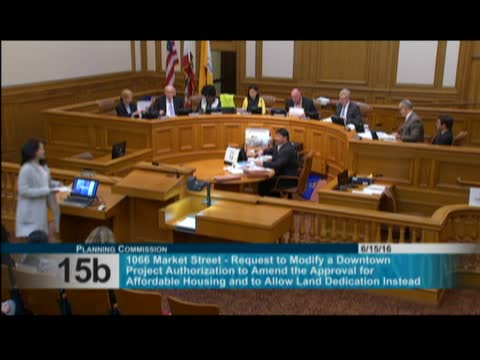
Deal to turn 101 Hyde into 85–87 permanently affordable units wins commission support despite staff caution on TDR exemption
Summary
Developer Shorenstein agreed to dedicate 101 Hyde to the city and to contribute funds toward construction in exchange for planning code changes allowing land dedication instead of on‑site inclusionary units and an FAR/TDR exemption for 21,422 sq ft at 1066 Market; Planning staff warned fiscal and precedent concerns but the commission voted unanimously to recommend the package to the Board.
A negotiated package that would trade an on‑site inclusionary obligation at 1066 Market Street for a land dedication and funding to build a separate 100% affordable project at 101 Hyde drew broad neighborhood support and unanimous approval from the Planning Commission, though planning staff advised caution.
Supervisor Kim and developer Shorenstein presented the arrangement: Shorenstein would dedicate the 101 Hyde site (the former post office) and provide several million dollars of predevelopment funding; the mayor's housing office and community partners (TNDC, Hospitality House, Market Street for the Masses) argued the trade produces deeper and more locally appropriate affordability than the in‑lieu alternative. The Mayor's Office of Housing told the commission the land dedication would generate about 85–87 permanently affordable units targeted to Tenderloin residents.
Planning Department advice: Staff supported the project's housing production but recommended that the Board not exempt the 21,422 sq ft from FAR calculations nor waive the requirement to buy transfer‑of‑development rights (TDRs) because of missing fiscal analysis and concerns about precedent and program integrity. Staff estimated the TDR exemption would reduce support for the TDR program by about $500,000.
Why it matters: The land‑dedication approach would place deeply affordable, neighborhood‑serving units on an important Tenderloin site rather than housing the inclusionary units at 1066 Market itself, which staff said likely would offer higher‑income BMR units less accessible to existing neighbors. Community groups argued the package better matches local need.
Vote and next steps: The commission voted unanimously (6–0) to recommend approval with the commission's suggested conditions; staff said an appraisal and fiscal analysis are still pending and the Board of Supervisors will take the final action.