Get Full Government Meeting Transcripts, Videos, & Alerts Forever!
Get email alerts on the State Streamlining Bill topic
No spam. Unsubscribe anytime.
Planning staff warns of uncertainties as state seeks to streamline housing approvals
Summary
Planning Department staff told the commission the governor's 'Streamlining Affordable Housing Proposals' would route some qualifying housing projects to ministerial approval, shorten review clocks and remove CEQA for certain sites, but staff said the bill's vague language leaves unresolved questions about historic protections, variances and how local inclusionary rules would apply to replacements.
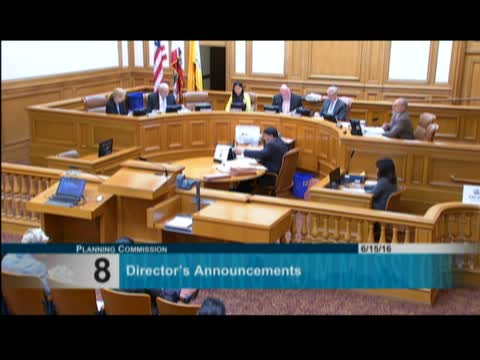
Planning Department staff briefed the San Francisco Planning Commission on a rapidly changing state proposal the governor introduced to speed housing approvals statewide, saying the bill would make some residential projects "by right" if they meet objective standards and provide set levels of affordability.
"This is legislation that is intended to make certain types of residential projects by right statewide," Anne Marie Rogers, Planning Department staff, told the commission. She said the legislation would remove CEQA review for qualifying projects and impose short, statutory review clocks: 30 days to determine compliance with objective standards and a 90‑day window for limited design review that "cannot chill, inhibit, or preclude ministerial approval." Rogers cautioned the commission that the bill's text has changed several times and still leaves many operational questions unanswered.
Why it matters: If enacted in its current form, the bill could significantly limit San Francisco's discretionary review tools for design and environmental protections on projects that otherwise meet objective zoning and general plan standards. Staff said the statewide language does not map cleanly onto San Francisco's code vocabulary and could undercut local processes for historic resources, inclusionary requirements and conditional use reviews.
What staff told commissioners: Kate Connor, another planning staffer, explained how the bill would define eligible sites as "designated housing sites" (those identified in the general plan, planning code, zoning map or mitigated in an EIR) and restrict eligibility in places such as prime farmland, wetlands, very high fire hazard zones and FEMA floodplains. She also described the affordability tests that vary by proximity to transit: projects in transit priority areas would need 10% low‑income or 5% very‑low‑income units to qualify for ministerial review, while lower‑transit areas would require roughly 20% at 80% AMI or less.
Public reaction: Public commenters were split. Supporters argued that city rules already codify many mitigation standards that CEQA historically addressed — flood, shadow, greenhouse‑gas checklists and historic soil ordinances — and that the bill could speed routine projects. Opponents, including neighborhood speakers, warned that removing CEQA review could accelerate displacement in neighborhoods experiencing rapid change.
Next steps: Staff urged caution and recommended the commission and city continue to refine a shared position to bring to the Board of Supervisors and Mayor's Office. The Planning Department said it will continue to track the bill as it evolves at the Legislature.