Get Full Government Meeting Transcripts, Videos, & Alerts Forever!
Get email alerts on the Closed Session Privilege topic
No spam. Unsubscribe anytime.
San Francisco Planning Commission asserts attorney–client privilege, moves into closed session and votes not to disclose
Summary
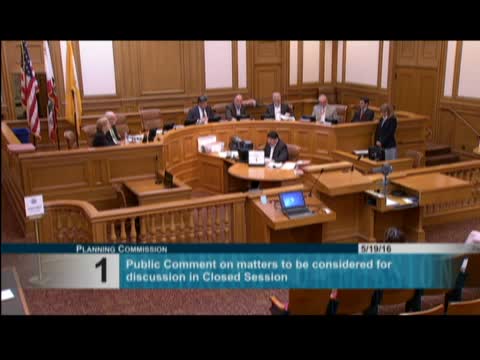
At a May 19, 2016 special meeting the San Francisco Planning Commission voted to assert attorney–client privilege for items to be discussed in closed session, recess into closed session, and later voted 7–0 not to disclose any portion of those discussions, reporting no action in open session.
SAN FRANCISCO — The San Francisco Planning Commission voted on May 19, 2016 to assert attorney–client privilege for matters listed for discussion with legal counsel, recessed into closed session and, upon returning to open session, unanimously voted not to disclose any portion of the closed-session discussions.
During the special meeting, the commission’s moderator introduced Item 2, a motion “to assert the attorney client privilege regarding the matters listed, below on your agenda as conference with legal counsel.” Commissioner Antonini moved the motion and it was seconded; Commissioners Antonini, Hillis, Moore, Richards and Commission President Fong each recorded “Aye,” and the motion passed 5 to 0.
After a brief recess the commission convened in closed session. Government television identification (ESSA GovTV / SF GovTV) was read for the record while the body was moving into closed session.
On returning to open session, the commission considered whether to disclose any part of the closed-session discussions. As the moderator put it, “There is a motion that has been seconded to not disclose any part of the discussions during closed session.” Commissioner Moore initiated the motion on the floor; the motioned was seconded and the roll call votes were: Antonini, Hillis, Johnson, Moore, Wu, Richards and President Fong — all “Aye.” The motion to withhold disclosure passed unanimously 7 to 0.
The moderator reported to the public that “no action was taken by the Planning Commission” in closed session, and the meeting was then adjourned.
The votes are formal minutes-level actions that record the commission’s invocation of attorney–client privilege and the subsequent decision to withhold disclosure of closed-session discussion; the commission did not announce any substantive decisions or actions arising from the closed session.