Get Full Government Meeting Transcripts, Videos, & Alerts Forever!
Get email alerts on the Institutional Master Plan topic
No spam. Unsubscribe anytime.
Planning Commission reviews Academy of Art existing-sites memo amid neighborhood outrage over conversions
Summary
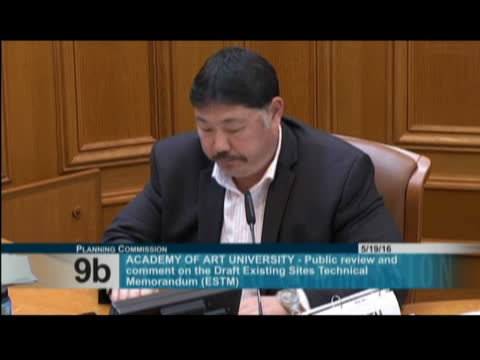
Planning staff presented an existing-sites technical memorandum (ESTM) on May 19, 2016 that evaluates 34 Academy of Art University properties and recommends preliminary disapproval for 11 sites; public speakers accused the university of years of illegal conversions and called for enforcement, new housing construction, and stronger mitigation. The Commission asked staff to return with the EIR certification and focused analyses in July.
Planning staff presented a comprehensive Existing Sites Technical Memorandum (ESTM) for the Academy of Art University (AAU) on May 19 and outlined preliminary policy recommendations for the 34 existing sites the department reviewed. The ESTM analyzes past unpermitted conversions, recommends conditions of approval and transportation-demand measures, and identifies 11 sites where staff is currently inclined to recommend disapproval of legalization requests.
Staff said enforcement actions are already underway: the zoning administrator issued notice-of-violation and penalty decisions for 22 properties that AAU has appealed; failure to publish environmental responses by July 1 could trigger penalties that staff summarized on the record. Chelsea Fordham (Planning Department coordinator for the ESTM) explained the ESTM’s scope: it assesses environmental effects of past nonpermitted work, recommends conditions (historic preservation repairs, window and awning changes, improved bicycle parking and TDM measures), and provides a transportation demand management program for AAU properties.
The presentation sparked sustained public comment. Neighbors, housing advocates and community groups sharply criticized AAU, alleging long-running conversions of SROs and other housing to student use without permits and urging the Commission to require AAU to build replacement housing and to collect fines. Sue Hester and other speakers said the conversions had “decimated a neighborhood,” and multiple commenters demanded that the Commission require restitution, stronger enforcement and a clear timeline for AAU compliance. Concerns about shuttle vehicle idling, double-parked private shuttles and greenhouse-gas impacts were raised repeatedly.
AAU’s representative (Zane Gresham, Morrison & Foerster) acknowledged the controversies, described the Academy’s student housing and campus footprint, and offered public benefits the institution proposes to supply if approvals move forward (including dedicating a dormitory for long-term affordable housing and providing $10 million in impact fees). The Academy asked the Commission to consider a development agreement as a tool to secure performance and enforcement of any conditions.
Commissioners praised the ESTM as a model of detailed staff work and requested additional analysis before individual site decisions. The Commission asked staff for: (1) benchmarking on the share of students housed by comparable urban institutions; (2) ownership histories and eviction/buyout records for contested buildings where possible; (3) an accounting of potential fines and past-fee liabilities; (4) a focused transportation overlay linking student housing locations to academic uses to assess trip impacts; and (5) coordination with Historic Preservation staff on properties that require certificates of appropriateness. Director Webb said the draft EIR certification and related initiation items are scheduled to return in July (staff suggested July 28 for EIR certification).
Next steps: Staff will return with the final EIR certification package and detailed site-level recommendations in July; individual conditional-use and planning-code amendment applications will be considered by the Commission in subsequent hearings. The Commission encouraged staff to incorporate public comments and to prepare a clear accounting of outstanding enforcement penalties and proposed mitigation measures.
Quote from the hearing: A frequent public theme was: “They should be required to build housing” and officials repeatedly asked staff to “explain where conversion is acceptable and where it is not,” reflecting a desire for precise criteria tied to neighborhood impacts.
The Commission did not approve site-level entitlements on May 19; it asked staff to return with the EIR certification and supplementary analyses and to schedule follow-up hearings in July.