Get Full Government Meeting Transcripts, Videos, & Alerts Forever!
Get email alerts on the Plan Bay Area topic
No spam. Unsubscribe anytime.
ABAG outlines three scenarios for Plan Bay Area 2040; local planners press for displacement and resilience responses
Summary
ABAG presented three draft scenarios for the Plan Bay Area 2040 update—Main Streets, Connecting Neighborhoods and Big City—prompting San Francisco commissioners and public speakers to press for stronger displacement protections, resilient infrastructure planning and clearer links between regional housing, jobs and transit investments.
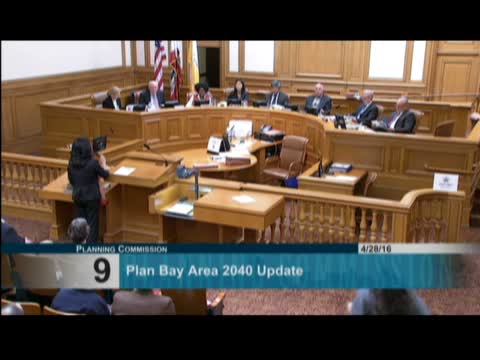
Representatives from the Association of Bay Area Governments (ABAG) briefed the Planning Commission on April 28 about initial scenarios for the Plan Bay Area 2040 forecast and the update’s broad priorities of sustainability and equity.
ABAG outlined three scenarios: a dispersed 'Main Streets' approach emphasizing smaller cities and suburban growth; a 'Connecting Neighborhoods' scenario that concentrates growth in the three big cities and transit corridors; and a 'Big City' scenario that concentrates most growth in San Francisco, Oakland and San Jose. ABAG said the revised forecast raises totals to roughly 1.3 million jobs and over 800,000 housing units for the planning horizon. The presentation stressed resilience to climate and seismic risks and attention to displacement pressures.
Commissioners and public speakers focused their questions on the political and fiscal feasibility of sharing impact fees across jurisdictions, distributional consequences of locating most growth in transit nodes (which can increase displacement in already low‑income neighborhoods), and the need for up‑to‑date neighborhood plans tied to PDAs. Commissioner Wu warned that concentrating PDAs on the poorest neighborhoods could accelerate displacement and urged more anti‑displacement tools in the plan. Local speakers called for stronger regional mechanisms to require employers in suburban counties to contribute to housing and transit costs in the high‑demand cities.
ABAG and city staff said the scenarios are intentionally illustrative and will be refined with local input; the draft plan will be updated through public engagement, technical analyses and a four‑year forecast revision cycle. The commission requested more concrete fiscal and infrastructure analyses to accompany scenario choices.