Get Full Government Meeting Transcripts, Videos, & Alerts Forever!
Get email alerts on the Public Space Policy topic
No spam. Unsubscribe anytime.
Planning Department outlines 'Places for People' permit to streamline tactical urbanism
Summary
City planning staff presented a legislative package to consolidate permits for parklets, plazas and temporary street activations into a single 'Places for People' permit to reduce interagency silos, increase predictability, and improve stewardship and monitoring in underserved neighborhoods.
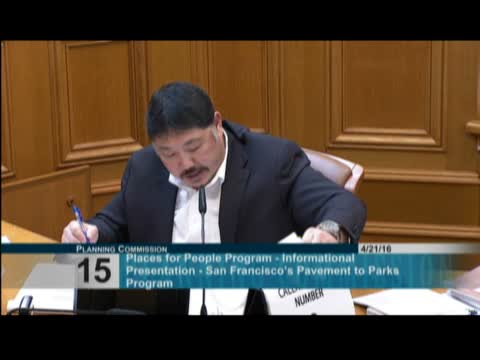
Planning Department staff on April 21 outlined a legislative package to create a unified 'Places for People' permitting process to make tactical urbanism projects — parklets, plazas and temporary street activations — easier to apply for and manage.
"The central premise of Pavement to Parks has always been about nurturing the grassroots in the short term with demonstrations and experiments in order to bring about longer term institutional change," Robin Abad, City Design Group staff, told the commission. Staff framed the legislation as the next step in the city’s Pavement to Parks program, proposing three core reforms: a single integrated permit for different project types; clearer, more transparent public review; and a predictable stewardship and monitoring framework to sustain community-sponsored spaces.
Neil Rishawi, manager of the city design group, described how the program would reduce barriers by consolidating review across planning, Public Works, MTA and other agencies, and by creating operating frameworks and monitoring protocols so communities can steward spaces sustainably. "We now use tactical urbanism as a standard tool to engage the community," Rishawi said.
Commissioners asked about staffing, timelines, liability and monitoring. Staff said the program had received dedicated staff allocations this fiscal year and estimated typical parklet projects can take about a year to 18 months from proposal to implementation; larger plazas can require more time and interagency coordination. Staff also explained insurance requirements: stewards will generally carry liability insurance during operating hours, reverting to city liability outside those hours.
Public-sector stakeholders and business-improvement representatives—including the Union Square BID director—praised the consolidation as a way to overcome procedural barriers and increase activation in high-need neighborhoods. The item was informational; staff expects to advance draft legislation to the Board of Supervisors in late spring or early summer.