Get Full Government Meeting Transcripts, Videos, & Alerts Forever!
Get email alerts on the Wireless Telecom Code topic
No spam. Unsubscribe anytime.
Planning Commission initiates wireless facilities code changes to better manage small cells and screening
Summary
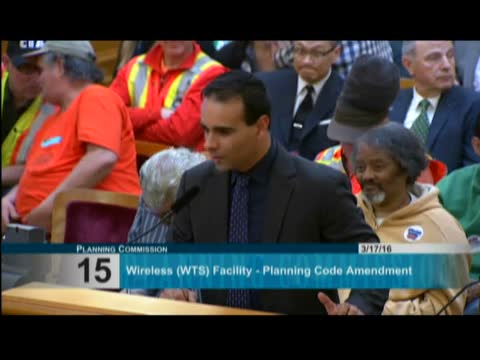
Commission voted to initiate planning code amendments to clarify design and permitting of wireless facilities, including defining micro facilities and a proposed 10‑year term on conditional use authorizations; carriers urged technical refinements and opposed a uniform 10‑year term.
Planning Department staff recommended and the commission voted to initiate proposed planning code changes on March 17 to address the proliferation of wireless facilities in San Francisco. The proposal would clarify the ability for screening elements to exceed local height limits in certain contexts, create a definition and permitted pathway for smaller micro facilities (small cells), and place a 10‑year duration on conditional use authorizations for certain wireless facilities so staff can review obsolete or substantially changed installations at regular intervals.
Staff said the changes aim to preserve design review and historic preservation safeguards while allowing carriers and property owners practical options to reduce visual clutter (for example, by moving rooftop antennas into screened penthouse elements when appropriate). Staff also noted the continuing trend toward densification networks and deployment of hundreds of small cells on light and transit poles.
Public comment included Internet service providers and major carriers. Webpass urged the City to treat the Internet as a ubiquitous utility and consider an Internet franchise; Verizon and AT&T asked staff to refine the technical definitions (arguing effective radiated power and antenna counts are imperfect proxies for facility size and emissions) and warned against a blanket 10‑year term that could create administrative burdens. Commissioners generally supported the initiation and the principle of creating a micro classification while asking staff to work further with carriers on definitions; the motion to initiate and send the draft to the Historic Preservation Commission passed unanimously.