Get Full Government Meeting Transcripts, Videos, & Alerts Forever!
Get email alerts on the Affordable Housing Bonus Program topic
No spam. Unsubscribe anytime.
Planning Commission forwards Affordable Housing Bonus Program to supervisors with no overall recommendation after marathon hearing
Summary
After a daylong staff presentation and hours of public testimony by hundreds of speakers for and against, the Planning Commission forwarded the Affordable Housing Bonus Program (AHBP) to the Board of Supervisors with no overall recommendation and adopted several topic‑level recommendations on eligibility, design, review, small‑business protection and affordability.
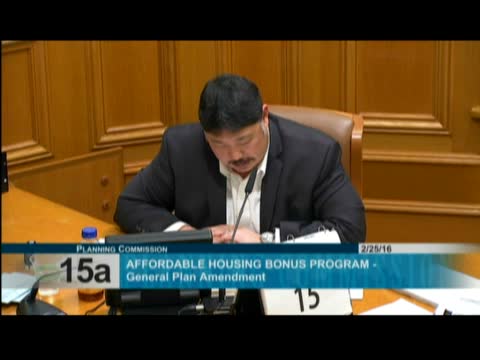
The Planning Commission on Feb. 25 sent the city’s proposed Affordable Housing Bonus Program (AHBP) to the Board of Supervisors without a formal recommendation, after a daylong staff briefing and a marathon public hearing that ran for hours.
Supervisor Katie Tang and Planning Department staff described the AHBP as a local, optional alternative to the state density‑bonus law. The local program would offer incentives — principally up to two additional stories of height plus some state‑law concessions — in exchange for higher on‑site affordability: staff and consultants projected the local program could yield as many as 5,000 permanently affordable units citywide over time if broadly used. The proposal includes three tracks: a state‑analyzed density bonus path, a local program that targets 30 percent on‑site affordability, and a 100‑percent affordable track designed to maximize affordable unit production.
Staff briefed commissioners on six policy clusters — program eligibility, infrastructure (transportation/childcare), urban design, the entitlement and appeals process, small‑business protections and affordability targeting — and proposed ten staff amendments based on more than 20 public meetings and follow‑up work. Among the key eligibility changes staff proposed were exclusions for known historic resources and a recommendation to bar projects that would demolish existing occupied housing (rent‑controlled or otherwise) from participating. Staff also produced a “soft sites” inventory (roughly 240 candidate parcels) as a first set of likely redevelopment opportunities.
Public testimony spanned the political spectrum. Supporters — unions, many housing advocates and several development firms — said the local AHBP would produce more affordable units without public subsidy and deliver middle‑income and some ownership opportunities that the city currently provides only in very small numbers. Critics — many neighborhood and small‑business groups, preservationists and some residents — said the program amounted to citywide upzoning, risked displacement of existing residents and merchants, and demanded neighborhood‑specific planning (charrettes) and stronger protections before upzoning was implemented. “This is a de‑facto rezoning of large parts of the city,” one neighborhood speaker said; others argued the city should pilot the program only on vacant and underutilized “soft sites” such as parking lots and gas stations.
After extended deliberation, the commission voted topic‑by‑topic. Major topic outcomes included: (1) program eligibility — commissioners directed staff to exclude any parcel that contains existing residential units from participating and to phase the program beginning with underused soft sites, while directing staff to further analyze value‑recapture and historic and small‑business impacts; (2) infrastructure — commissioners asked the Board to consider appropriate fee structures but made no changes to staff’s transportation fee assumptions; (3) urban design — the commission asked staff to develop more detailed design guidelines and recommended prohibiting lot mergers until the commission has approved site‑specific guidance; (4) review/appeals — the commission recommended that local program projects be reviewed with a consolidated entitlement process and that appeals go to the Board of Supervisors; (5) small business protections — the commission recommended measures including early notification, a right of first return and further development of a relocation/assistance fund working with OEWD and the Small Business Commission; and (6) affordability — commissioners asked staff to explore neighborhood‑specific rent benchmarks and to refine the AMI targeting so that portions of the middle‑income units could be set at lower AMIs where financial feasibility allows.
Finally, the commission voted unanimously to forward the AHBP package to the Board of Supervisors with no overall recommendation but with the topic‑level directions noted above. Several commissioners said the split votes on some topics underscored the program’s broad public interest and complexity.
What happens next: The Board of Supervisors will receive the Planning Commission’s record, staff recommendations and topic‑level votes; the commission’s stance is advisory. The Board will weigh the general plan amendment (if passed by planning) and the planning‑code changes and may modify AHBP language before deciding whether to enact a local density‑bonus alternative.