Get Full Government Meeting Transcripts, Videos, & Alerts Forever!
Get email alerts on the Inclusionary Housing topic
No spam. Unsubscribe anytime.
Planning Commission backs supervisors’ plan to move inclusionary rules into code, recommends technical fixes
Summary
The Planning Commission voted 4–3 to recommend approval of an ordinance that would move the city’s inclusionary housing rules from the charter into the planning code and raise on‑site affordability requirements for large projects, while adding a phased grandfathering schedule and a recurring feasibility study. The commission directed staff and the Board to clarify entitlements and carve‑outs.
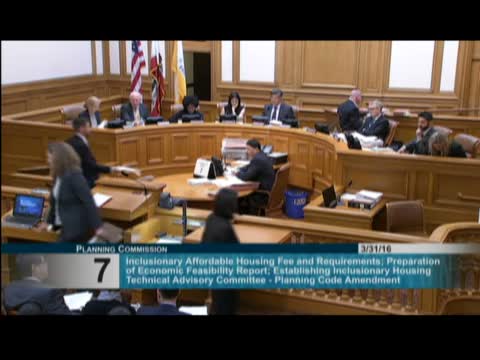
San Francisco’s Planning Commission on March 31 recommended that the Board of Supervisors approve a comprehensive ordinance to move inclusionary housing requirements out of the city charter and into the planning code and to increase on‑site inclusionary obligations for large projects.
Supervisor Jane Kim, a co‑sponsor of the measure, told the commission the proposal is intended to deliver more low‑, middle‑ and moderate‑income units by creating a tiered system. “For projects of 25 units or more we are raising the on‑site affordability to 25%,” Kim said in her presentation, adding that the measure would set separate shares for low/very‑low and middle‑income units and would apply grandfathering tiers based on the date an applicant filed a completed environmental evaluation application.
Planning Department staff outlined the ordinance’s main elements and recommended edits to reduce legal ambiguity and to protect projects in the pipeline. Staff explained the bill would: create a tri‑annual economic feasibility study and a technical advisory committee run out of the Controller’s Office, permit a new off‑site acquisition option to satisfy some inclusionary obligations, and set stronger on‑site obligations for larger or taller projects while tightening rules on in‑lieu fees.
The commission’s discussion centered on fairness to projects already in the pipeline, neighborhood carve‑outs that would treat some Eastern Neighborhoods UMU and SoMa properties differently, and the mechanics and timing of a grandfathering regime. Support groups including Mission neighborhood advocates and labor and community organizations urged stricter treatment for projects in parts of the city that have experienced displacement. Developers, investors and trade groups warned that uneven or late changes could make already‑entitled projects infeasible and harm jobs.
Commissioners voted 4–3 to transmit a recommendation of approval to the Board that incorporates many of staff’s technical changes and asks the Board to exempt projects that had received planning entitlements before June 7, 2016, from higher requirements. The motion also directed staff to clarify that the earliest environmental evaluation (EEA) submission date should serve as the baseline for grandfathering and to ask the Board to consider limited special circumstances for projects long in process.
Next steps: the commission’s recommendation will go to the Board of Supervisors as part of the trailing legislation package tied to the ballot charter amendment. The ordinance as drafted would only take effect if voters approve the companion change that returns inclusionary percentages to the legislative process. The Controller’s feasibility study called for by the bill is scheduled as an early deliverable to guide later adjustments.