Get Full Government Meeting Transcripts, Videos, & Alerts Forever!
Get email alerts on the Housing 88 Arkansas topic
No spam. Unsubscribe anytime.
Commission approves 88 Arkansas project after contentious debate over 'nested' bedrooms and unit-mix exception
Summary
The Planning Commission approved a 127-unit development at 88 Arkansas with 20% on-site affordable units but granted exceptions — including for dwelling-unit exposure — after extensive testimony both supporting and opposing so-called 'nested' (internally-lit) bedrooms; the vote was 4–2.
The Planning Commission on March 3 approved a large-project authorization for 88 Arkansas, a 127-unit, five-story residential building with ground-floor retail, 98 parking spaces and a commitment to 20 percent on-site below-market-rate units (25 BMR units). The approval included exceptions to several planning-code standards — rear yard, dwelling-unit exposure, off-street loading and unit-mix rules — and passed 4–2, with Commissioners Moore and Richards voting no.
The hearing focused on an interpretation of Eastern Neighborhoods unit-mix rules and a frequent modern layout known in the transcript and testimony as "nested" bedrooms. Nested-bedroom units position bedrooms away from the exterior façade (behind a glazed living area) so the living room takes the street-facing glazing while the bedrooms are set back. Martin Building Company, the sponsor, and multiple residents and local groups argued these units produce quieter, more usable living rooms and that the nested design has proven successful in earlier local projects. An acoustical consultant reported nested bedrooms measured about 15 decibels quieter in a case study cited at the hearing.
Opponents — including the Patrol Boosters neighborhood association and Friends of Jackson Park — argued Eastern Neighborhoods rules were written to ensure externally-facing bedrooms for family suitability and that the commission should not grant an exception without the high bar of findings required for section 3.29 modifications. Critics raised concerns about egress, light and long-term habitability for children in interior bedrooms and about the cumulative loss of local PDR (production, distribution, repair) commercial space to residential conversions.
Planning staff and the zoning administrator explained the technical background: building-code changes in 2009 loosened natural-light requirements for sleeping rooms, which prompted a 2012 department information bulletin and later interpretations for Eastern Neighborhoods that require bedrooms to have exterior exposure for unit-mix counting. Staff said the 88 Arkansas nested bedrooms meet building-code glazing and interior-opening standards (mechanical ventilation and a minimum glazed opening to the living area) but do not meet the stricter Eastern Neighborhoods interpretation and therefore required an exception; staff concluded the project meets the criteria for exceptions and recommended approval. The developer also offered a voluntary increase to 20% on-site affordable housing, which staff highlighted as a priority-processing criterion.
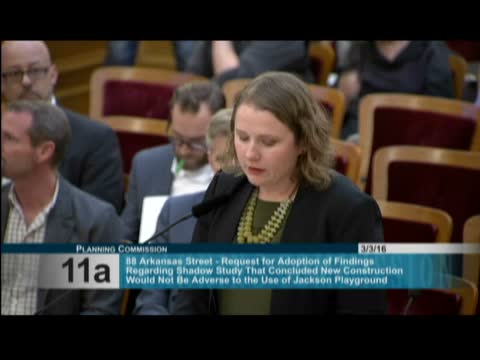
After several hours of testimony from pro- and anti-project speakers — labor unions, affordable-housing advocates, neighborhood groups, and many residents — the commission adopted required shadow findings for Jackson Playground and approved the large-project authorization with the noted exceptions and conditions (including entertainment-commission conditions and remediation/park coordination items). Commissioners Moore and Richards recorded no votes, citing concerns about family housing quality and the interpretation's precedent-setting effect.
Next steps: Project conditions require coordination on construction mitigation, remediation of contaminated soils where applicable, and further coordination with Recreation & Parks and DBI for detailed code compliance. The developer will proceed with building permits and the design team will finalize construction documents consistent with the commission’s conditions.