Get Full Government Meeting Transcripts, Videos, & Alerts Forever!
Get email alerts on the Candlestick D4d topic
No spam. Unsubscribe anytime.
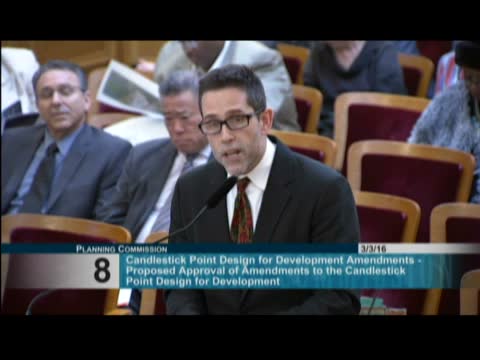
Planning commission approves Candlestick Point D4D amendments despite State Parks objection
Summary
The Planning Commission approved amendments to the Candlestick Point Design-for-Development, including modest height changes and relocation of three towers (notably Tower G), over a formal objection from California State Parks about the park-edge visual impacts.
The Planning Commission voted unanimously March 3 to approve amendments to Candlestick Point’s Design-for-Development (D4D), a long-running master plan for the Hunters Point/Candlestick redevelopment. The amendments include three tower relocations, modest increases in height at selected retail/performing-arts corners, and refinements to street and block phasing intended to reflect changed phasing and the retail center’s evolving pedestrian circulation.
Planning staff and the master planner argued the changes are consistent with the original urban-design intent and necessary to address phasing and access constraints. David Tom, the urban designer who authored the original D4D, said moving Tower G from the interior of the retail hub to a perimeter location improves vehicular access and aligns tower phasing with the retail schedule; he and staff said shadow and visual analyses show limited adverse views and that tighter architectural controls will govern tower form.
California State Parks opposed the relocation of Tower G. Steve Masalami, manager of planning and design for Northern California State Parks, told commissioners that Tower G’s new location would be "inconsistent with the goals and guidelines" of the park’s 2012 general plan and would adversely affect the quiet visitor experience in the Lastport area of Candlestick Point State Recreation Area. State Parks said the relocated tower is taller and closer to park vistas and urged reconsideration.
Local community leaders and the Hunters Point Citizens Advisory Committee strongly supported approval, citing long-term economic and job benefits, minority and local-business participation in the construction program, and improvements to open space and connectivity. Several commissioners pressed project designers on park-edge design, massing, and orientation; project staff said refined base treatment, architectural orientation and landscaping will soften the interface and that moving one tower improves overall phasing and access.
Commissioner Moore moved for approval; the motion passed 6–0. Commissioners’ statements, planning staff analysis and submitted visual and shadow comparisons accompany the vote. Planning staff noted State Parks’ concerns were circulated and that OCII and Lennar Urban will continue coordination with State Parks on design refinements as the project proceeds to OCII and subsequent design-review steps.
Next steps: OCII (the successor agency handling disposition and development agreements) will consider companion approvals and design-detail reviews; project-level architecture will return for design review consistent with the D4D amendments.