Get Full Government Meeting Transcripts, Videos, & Alerts Forever!
Get email alerts on the Administrative Jurisdiction topic
No spam. Unsubscribe anytime.
Board asks SFMTA to pause and collaborate before removing taxi appeals from Board of Appeals
Summary
The Board of Appeals asked San Francisco Municipal Transportation Agency (SFMTA) to slow its planned move away from BOA review of taxi permit appeals and directed staff to draft a letter urging safeguards for hearing‑officer independence, estoppel considerations and public notice.
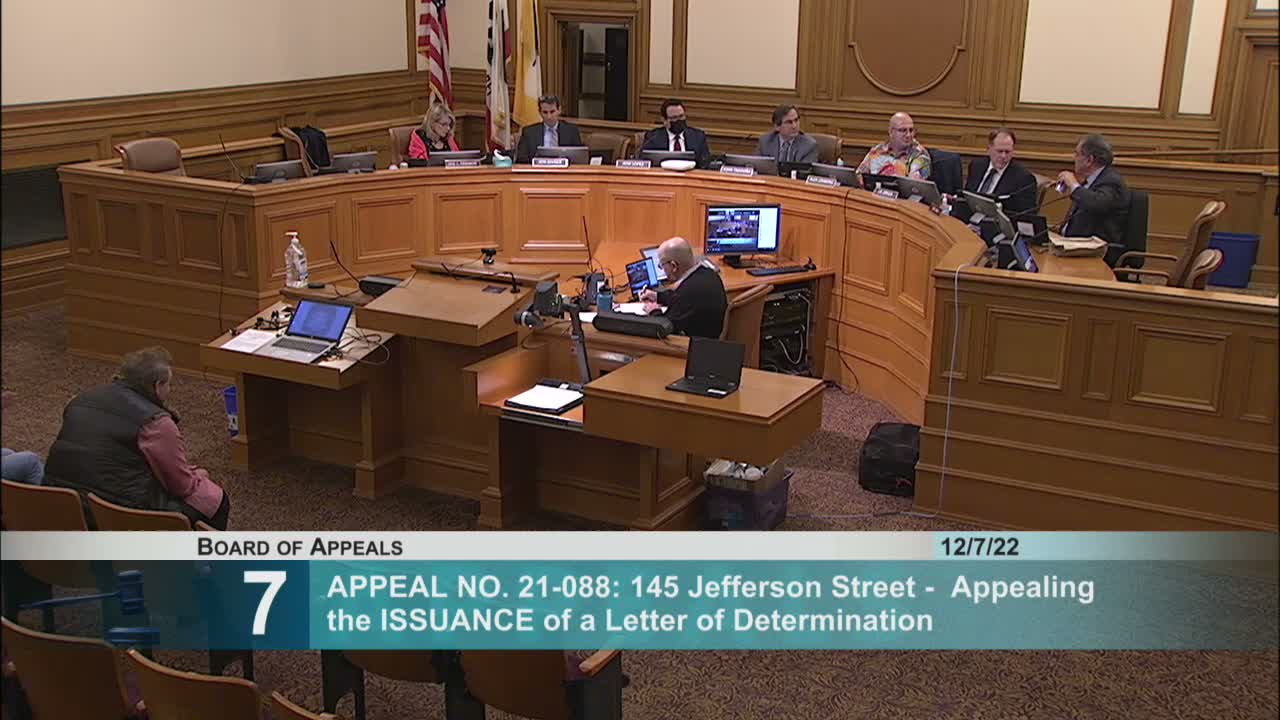
The San Francisco Board of Appeals and representatives of the San Francisco Municipal Transportation Agency discussed SFMTA’s recent notice that it planned to discontinue Board of Appeals review of taxi permit decisions.
Kate Torren, director of the SFMTA Taxi, Access and Mobility Services division, told the board the agency had "taken a step back, reset on the process" after earlier conversations and would like to meet with the board in early 2023 to continue collaboration. "In light of comments that we heard at that meeting, SFMTA has decided to take a step back, reset on the process, and therefore sent the letter to the Board of Appeals about allowing more time for collaboration between the two bodies," she said.
Commissioners urged that any transfer of jurisdiction preserve key safeguards: clear independence for hearing officers, transparent reconsideration pathways, and protection for appellants who rely on BOA review rights. Vice President Jose Lopez suggested two focus areas for a formal letter: whether SFMTA’s proposed hearing structure ensures independence comparable to the BOA and, if SFMTA proceeds, whether the hearing framework will include explicit considerations such as estoppel and the balancing of enforcement interests against appellants’ injuries.
The board directed the executive director, in collaboration with Vice President Lopez, to draft a letter laying out these concerns and suggested safeguards and to return the draft for adoption at the board’s Jan. 4 meeting. The motion to prepare the letter was adopted 5–0.