Get Full Government Meeting Transcripts, Videos, & Alerts Forever!
Get email alerts on the Transportation Vmt topic
No spam. Unsubscribe anytime.
Planning commission adopts VMT as CEQA metric, replacing LOS
Summary
The Planning Commission unanimously approved a resolution to replace level-of-service (LOS) automobile-delay analysis with vehicle miles traveled (VMT) as San Francisco’s primary CEQA transportation metric, citing alignment with safety and climate goals and California Senate Bill 743.
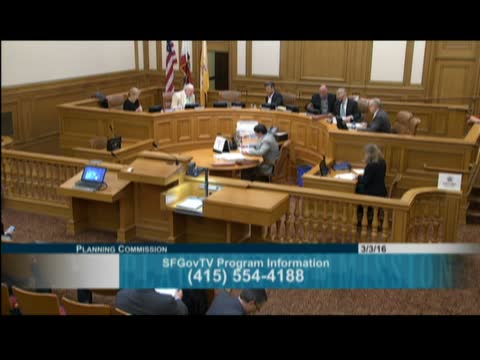
San Francisco’s Planning Commission on March 3 voted unanimously to adopt a citywide change in how transportation impacts are measured under the California Environmental Quality Act, replacing the long-standing level-of-service (LOS) standard with vehicle miles traveled (VMT).
"It is absurd that here in this city we can't make our streets safer because it could inconvenience drivers," Planning Department Environmental Review Officer Sarah Jones told commissioners, arguing LOS is a 1950s highway-era metric that misaligns with San Francisco goals for transit, safety and infill development. Staff and agency speakers pointed to California Senate Bill 743 as the legislative driver of the change and framed early local adoption as a way to align CEQA with the city's Transit First and Vision Zero policies.
Wade Whitgraf, a Planning Department senior planner, explained the technical rationale: LOS assigns A–F grades based largely on motor-vehicle delay and can push agencies toward roadway widening and induced demand, while VMT measures the miles people are expected to drive — a closer proxy for greenhouse-gas emissions and population-level transportation effects. Whitgraf said that under the state's proposed guidance the regionwide baseline is about 17.2 miles per capita per day and the draft threshold is 15% below that average; on those metrics much of San Francisco would be below the threshold and thus treated differently than suburban locations.
City agencies voiced broad support. Tilly Chang of the Transportation Authority said the shift would “streamline review and achieve better outcomes” and SFMTA vice chair Cheryl Brinkman urged adoption to prioritize multimodal options and safety. Public-health and environmental presenters — including the Department of Public Health and the San Francisco Department of the Environment — said VMT better captures air-quality and safety effects than LOS.
Commissioners pressed staff on practical details: how thresholds will be applied, when level-of-service might still be used for project engineering, and how the Transportation Demand Management (TDM) ordinance and other mitigation tools will function alongside VMT. Planning staff and Transportation Authority modelers said the city will rely on regional model runs for neighborhood mapping and that the department intends to pair VMT with demand-management measures and city-specific guidance rather than simply default to state thresholds.
Public commenters from cycling, planning and housing advocacy groups testified in favor of early adoption. Supporters said the change would make it easier to implement protected bike lanes, transit priority and other safety projects that previously triggered LOS-based environmental review.
Commissioner Moore moved to adopt the change; the motion passed 6–0. Planning staff told commissioners the change does not remove public input from environmental review: other CEQA topics and public-comment periods will remain, and staff will continue to analyze safety, transit reliability and multimodal access in project-level reviews.
Next steps: the Planning Department will implement the new VMT-based guidance in its transportation-impact guidelines and coordinate with other city agencies on modeling, TDM requirements and project-level mitigation.