Get Full Government Meeting Transcripts, Videos, & Alerts Forever!
Get email alerts on the Transportation Policy topic
No spam. Unsubscribe anytime.
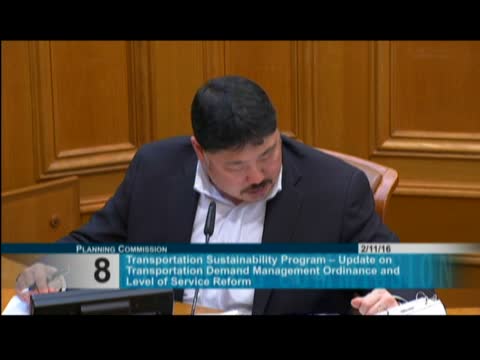
Planning Commission hears plan to replace LOS with VMT and adopt TDM ordinance
Summary
City staff outlined a Transportation Sustainability Program to shift CEQA transportation analysis from level-of-service to vehicle-miles-traveled and to create a new Transportation Demand Management ordinance using parking-based targets and a points menu; commissioners asked for monitoring, TNC study, and clearer compliance rules.
San Francisco planning and transit staff told the Planning Commission on Feb. 11 that the city is preparing to replace automobile delay (level of service) with vehicle-miles-traveled (VMT) for transportation impact analysis and to pursue an ordinance that would require developers to meet site-based VMT/trip-reduction targets.
The Transportation Sustainability Program presentation said state guidance and rulemaking (OPR) point the region toward VMT as CEQA’s threshold for transportation impacts. Carly Payne of SFMTA described three TSP components: Align (level-of-service reform), a proposed Transportation Demand Management ordinance, and a fee (TSF) that has already been under revision. Staff said the VMT approach compares a project’s expected vehicle miles with a regional average and that San Francisco generally scores well against the Bay Area baseline.
Wade Whitgraf of Planning described a draft TDM ordinance that would set developer targets tied to the number of off‑street parking spaces and allow sponsors to meet those targets using a menu of measures (bicycle parking, transit subsidies, parking management, etc.). Projects would submit a package of measures during review; staff would check pre‑occupancy and follow up with periodic compliance checks. The ordinance would reference an implementation handbook outside the code so the TDM menu could be updated by staff as research evolves.
Commissioners pressed staff on the modeling method and data sources for VMT, grandfathering rules, and how the city would account for shared‑ride services and TNC activity (Uber/Lyft). Michael Schwartz of the Transportation Authority said UC Berkeley is leading research into networked mobility’s net effect on vehicle trips and the city’s long‑range planning will explicitly consider shared mobility. Commissioners emphasized enforcement and requested a clear follow‑up and monitoring plan; staff said the department budget includes positions for TDM enforcement and research.
Next steps: staff said they plan additional outreach and hoped to introduce ordinance language to the Board of Supervisors in spring; planning will return to the commission for a March resolution on the level‑of‑service change and for formal recommendation on ordinance language later in the process.