Get Full Government Meeting Transcripts, Videos, & Alerts Forever!
Get email alerts on the Formula Retail Subsidiaries topic
No spam. Unsubscribe anytime.
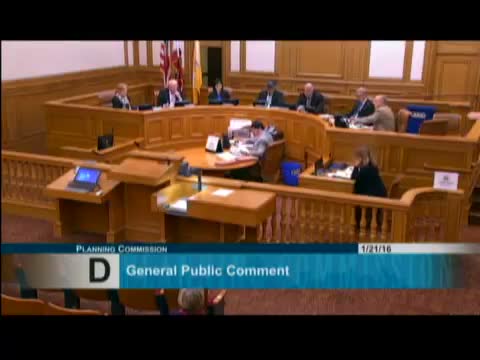
Planning Commission forwards Supervisor Marrproposal on subsidiaries with recommendation for disapproval after split debate
Summary
The Planning Commission reviewed Supervisor Marr (PCA 2015-11449) that would require conditional-use review of corporate spin-offs once a subsidiary opens three outlets worldwide; staff recommended disapproval citing enforcement and ownership-based regulation concerns, public testimony split, and the Commission ultimately forwarded a recommendation for disapproval and detailed comments to the Board of Supervisors.
Supervisor Marr brought a planning code amendment to the Planning Commission that would expand San Francisco formula retail definition to catch corporate subsidiaries and spin-offs, triggering a conditional-use (CU) process when a subsidiary reaches three locations worldwide.
Marr said the measure is "a simple solution to a problem" that emerged as companies increasingly introduce related spin-off concepts to market, and that the amendment is narrowly tailored to capture only subsidiaries of formula retailers and require a CU when certain ownership and physical-characteristic criteria are met. "It captures only such corporate spinoffs," Marr said, adding the test would include ownership ties, a three-outlet threshold for the subsidiary, and shared features such as standardized signage or decor.
Planning Department staff (Aaron Starr and Director Raimo) urged caution and recommended disapproval. The departmentreport noted investigating corporate ownership structures and enforcing an ownership-based rule would create a substantial administrative burden and could set a precedent for regulating businesses by ownership rather than land-use impacts. "As a department, we try to find ways to support an ordinance either through amendments or proposing a different approach to achieve the same goals," the Department stated, and concluded its recommendation is for disapproval.
Public testimony was sharply divided. Neighborhood groups and local-business advocates, including representatives from the Polk Street and Telegraph Hill merchant groups, urged the Commission to adopt stronger controls. "There is an 800-pound gorilla that is trying to weasel its way into Polk Street that would be a horrible threat to our independent local merchants," said Suzanne Marquel Fox of the Middle Polk Neighborhood Association, urging support for the proposal. Civic and neighborhood advocates argued the measure would close loopholes allowing national chains to proliferate under new names.
Business groups and trade associations countered the measure is unnecessary or unlawful, saying subsidiaries are rare and that the ordinance attempts to regulate owners rather than uses. "There is not a problem with subsidiaries of formula retailers in San Francisco," Didi Workman of the San Francisco Chamber of Commerce told commissioners, citing the departmentstudy finding less than 3% of retailers are subsidiaries. The Chamber urged the Commission to uphold staffrecommendation to disapprove.
Commission debate focused on two technical and policy questions: whether the rule improperly regulates by ownership and thus risks legal challenge, and whether the three-outlet threshold (versus higher thresholds) would sweep in locally grown businesses or small franchised operations. Commissioners proposed several alternatives during discussion, including raising the threshold, limiting the three-outlet test to outlets within the city, requiring affidavits from project sponsors, or creating a priority processing path instead of an automatic CU.
A motion to adopt the departmentrecommendation for disapproval was moved and resulted in a 3-3 tie, which failed. Commissioners then debated and offered ideas for refining the draft (raising thresholds, clarifying the affiliated-person language, or tying the subsidiary test more closely to the parent formula retail definition). Following further procedural motions, the Commission ultimately determined the matter will move forward to the Board of Supervisors with a recommendation for disapproval and with commissionerscomments and suggested refinements included in the transmittal record.
The next procedural step is for the Board of Supervisors to consider the ordinance; the Commissionrecord (including the Commissiondiscussion and the Departmentreport) will accompany the Board's review. The Commission did not adopt an approval recommendation; it forwarded its recommendation for disapproval and its discussion points for the Board to consider.