Get Full Government Meeting Transcripts, Videos, & Alerts Forever!
Get email alerts on the Housing Interim Controls topic
No spam. Unsubscribe anytime.
Planning Commission adopts revised interim controls for Mission to study displacement and affordable housing
Summary
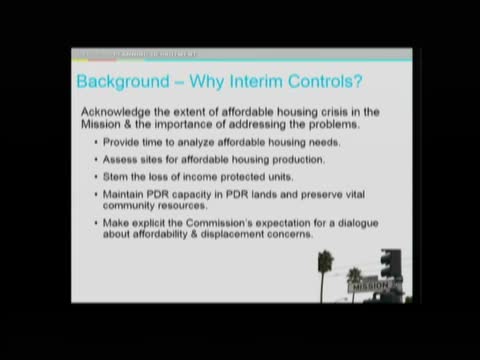
After months of hearings, the Planning Commission amended and adopted interim controls targeting medium and large projects in the Mission to require additional housing- and displacement-related studies, staff vetting of developer submissions, and a minimum affordability exemption for 33% equivalent land dedication. The package was amended to run 15 months and to add defined PDR protections.
The San Francisco Planning Commission on Jan. 14 voted to adopt revised interim controls aimed at giving staff and the commission more information about how new development in the Mission neighborhood affects affordability and displacement.
Planning Department staff presented a package of measures that would require medium and large projects within a specified Mission boundary to provide standardized information about total housing production, affordable housing production, housing preservation and tenant displacement, as well as inventories of nonresidential (PDR/arts/childcare) uses that would be removed. Staff said the controls are intended to increase scrutiny without changing zoning, height or the baseline planning code.
Commissioners amended staff’s proposal in several ways before voting to adopt it. The commission set the interim controls to remain in effect for 15 months (instead of the shorter or longer intervals debated), added a requirement that planning staff review and vet information submitted by project sponsors, clarified an exemption for projects that provide an equivalent of at least 33% affordable units through land dedication or other means, and required reporting on displacement metrics (including OMI and no-fault evictions) within a quarter-mile radius for medium and large projects.
Supporters of the controls—including neighborhood groups and tenant advocates—said the new requirements give the city time to complete its Mission Action Plan work and to gather better data on displacement and the rent-controlled housing stock. Speakers representing housing and development interests urged care not to impose burdens that would block production, and asked that existing studies and city data be usable by project teams rather than forcing costly new consultants.
The commission’s action preserves the Department’s ability to require additional case reports for projects that would otherwise proceed with standard reviews; it does not change statutory affordability thresholds in the inclusionary housing ordinance nor does it enact a moratorium. The commission also directed staff to return with clarified guidance for how the department will evaluate PDR (production, distribution and repair) uses and to propose how staff will be deployed at pre-application meetings for larger projects.
The controls were adopted as an interim policy to allow the department time to finish the Mission Action Plan and to coordinate any longer-term legislative changes that might follow. Next procedural steps include staff issuing guidance on the required materials and an expected return to the commission if permanent legislation or major edits are proposed.