Get Full Government Meeting Transcripts, Videos, & Alerts Forever!
Get email alerts on the Wireless Facilities topic
No spam. Unsubscribe anytime.
Planning Commission continues review of proposed Verizon rooftop cell site on Mission Street to Jan. 7 after tenant and commissioner concerns
Summary
Commissioners unanimously continued a conditional‑use review for a proposed Verizon rooftop wireless facility at 3120 Mission Street to Jan. 7, citing questions about noticing, residential rooftop uses and clearer site drawings; staff and consultants said RF exposures comply with FCC limits.
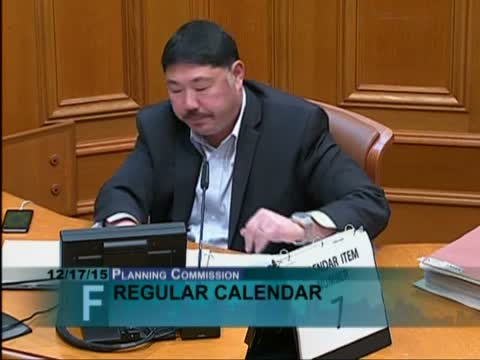
The Planning Commission voted unanimously on Dec. 17 to continue consideration of a conditional‑use authorization for a proposed Verizon Wireless rooftop facility at 3120 Mission Street to Jan. 7 to allow staff and the applicant to clarify noticing, site plans and the relationship of antennas to residential uses.
Omar Mazari of the Planning Department summarized the application, which proposes 12 panel antennas installed in three faux penthouses and equipment on the roof. The building, developed in 1956 and originally a Sears Roebuck store, was treated for CEQA and preservation review as if it were a potential historic resource; staff said they redesigned the proposal to avoid mounting antennas on the building's character‑defining tower.
During public comment Anne Bacon, who identified herself as a resident and tenant whose mailing address is 3435 Cesar Chavez (she said the building is commonly known by that address), told commissioners she and dozens of other tenants live above the site and that posted notices were not visible to many residents. She raised concerns about structural roof problems and the recent removal of rooftop plants from a communal garden.
Applicant representatives and the consulting engineer said they followed noticing rules, placed laminated signs at public frontages, and that the Department of Public Health reviewed an RF emission study prepared by Hammett & Edison and found modeled exposures would comply with Federal Communications Commission limits. Hammett & Edison’s Raj Mathur testified modeled levels at nearby buildings were, at the highest measured location, “less than 16% of the FCC limit.” Commissioners pressed for clearer drawings showing the residential entrance, the exact locations of penthouse residences and the distance from antennas (staff and applicant cited roughly 50 feet to the closest penthouse), and for a condition allowing free post‑installation RF testing on request.
Commissioner Johnson moved to continue the item so that the administrative record and the project materials reflect actual uses in the building and so commissioners could review clearer equipment drawings and analyses; Commissioner Moore seconded. The commission voted to continue the matter to the January 7 hearing.
Next steps: Staff and applicant will update the administrative record, provide clearer drawings locating residential units relative to the proposed antennas, and identify proposed mitigation measures such as child‑proof barricades or roof demarcation and confirm structural drawings for rooftop work. The commission will revisit the item at the continued hearing.