Get Full Government Meeting Transcripts, Videos, & Alerts Forever!
Get email alerts on the Cpmc Compliance topic
No spam. Unsubscribe anytime.
City staff recommend finding CPMC in compliance for 2014 while flagging charity‑care and CLAS issues
Summary
City staff recommended that the Planning and Public Health directors find California Pacific Medical Center in compliance with most 2014 Development Agreement obligations, while noting a charity‑care shortfall, outstanding CLAS (cultural and linguistic services) work, and ongoing steps to meet Tenderloin Medi‑Cal commitments.
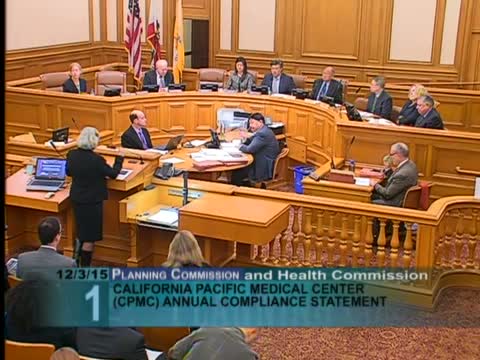
San Francisco planning and public‑health staff told the Planning and Health commissions on Dec. 3, 2015, that California Pacific Medical Center has met most of its development‑agreement obligations for the 2014 reporting year, though notable concerns remain around baseline charity care and culturally and linguistically appropriate services (CLAS).
Elizabeth Pearl of the Planning Department opened the joint hearing and summarized staff findings: staff will recommend that the Directors of Planning and Public Health find CPMC in compliance for calendar year 2014, and a third‑party monitor will subsequently review those determinations.
Colleen Shavla of the Department of Public Health detailed health‑care metrics. The DA requires CPMC to serve 30,445 unduplicated Medi‑Cal or charity‑care patients as a baseline. "In 2014 CPMC fell short of meeting this requirement by 1,849 patients," Shavla said, noting the DA allows a two‑year rolling‑average remedy. She reported CPMC exceeded the community‑benefit spending floor, expending about $14.6 million in 2014 against an $8 million annual minimum.
Shavla also said CPMC had accepted 16,247 new Medi‑Cal managed‑care beneficiaries, exceeding the DA target of 5,400. One DA subtarget requires 1,500 Tenderloin beneficiaries through a Tenderloin‑based partner; Shavla said that, as of Nov. 15, 2015, 17 beneficiaries had enrolled in the new NEMS–St. Anthonypartnership.
On workforce, Office of Economic and Workforce Development staff reported steady improvement. OEWD noted a construction‑workforce measure (percent of trade hours performed by San Francisco residents) at roughly 34% and that the program‑year hiring target of 40% of entry‑level positions filled via First Source was met in 2014 (41% or 80 of 196 hires).
Staff acknowledged implementation issues in the early years (delayed job notices, late hiring projections) but said CPMC now provides monthly reports and has funded workforce supports: CPMC paid $3 million into a workforce fund administered by the San Francisco Foundation to help barrier removal and job training. CPMC representatives also reported additional Innovation Fund contributions and described diagnostic‑service referrals to help make up the charity‑care shortfall.
Staff and commissioners underscored outstanding work: DPH requested additional material about CPMC's internal CLAS assessment and intends to proceed with an external peer review focused on the St. Luke's Diabetes Clinic. Shavla said the post‑acute/subacute care project launched with Dignity Health is wrapping up and a final report will be scheduled for the Health Commission in Jan.–Feb. 2016.
Next steps: the Directors of Planning and Public Health will issue formal determinations on compliance; a third‑party monitor will review those findings and report to the Board of Supervisors.