Get Full Government Meeting Transcripts, Videos, & Alerts Forever!
Get email alerts on the AHBP topic
No spam. Unsubscribe anytime.
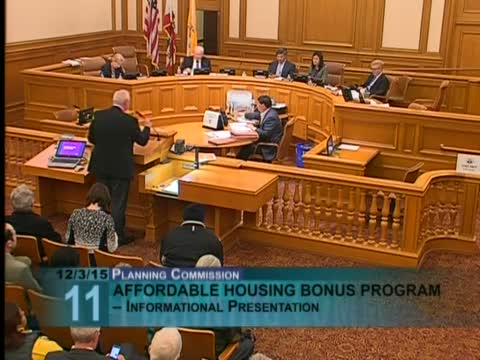
Planning Department previews Affordable Housing Bonus Program and pledges stronger tenant protections after vocal public response
Summary
Planning staff outlined a citywide Affordable Housing Bonus Program (AHBP) that would allow height/density increases in targeted commercial corridors in exchange for higher on‑site affordability, and promised to refine tenant protections and outreach after extensive public comment on displacement and lot‑merger risks.
Planning Department staff presented a multi‑part briefing on a proposed Affordable Housing Bonus Program that would give developers limited additional height and density on underutilized parcels in exchange for substantially more affordable units on‑site or via a state/local hybrid bonus. "For the purposes of this program, we define that as 120% AMI for rental and 140% AMI for ownership," Planning staff said in summarizing program definitions.
The proposal creates two tracks: a local program (a stronger local affordability requirement with an incentive of two additional stories) and an implementation of the state density bonus (where projects can secure bonuses under state law). Staff said they have identified roughly 240 “soft sites” — surface parking lots, gas stations and low‑rise parcels — where the program is most likely to produce new homes without demolishing existing housing.
Public comment was broad and intense. Housing developers, housing advocates and some planners urged adoption — arguing the AHBP could produce affordable and middle‑income units without additional subsidy and would unlock sites that otherwise would not develop. SPUR and Bridge Housing urged the Commission to move the program forward and monitor implementation closely.
Tenant and neighborhood groups pushed back hard, warning that a citywide bonus could incentivize demolitions, lot mergers and displacement — especially in neighborhoods with large stocks of rent‑controlled or small commercial storefronts. Tenant advocates urged stronger, enforceable “right to return” and relocation protections. Planning staff said they are working on a package of tenant protections, and highlighted AB 2222 (state law requiring 1:1 replacement for certain density bonus projects) as a helpful tool; staff also pledged to develop stronger right‑to‑return and relocation rules to be incorporated in substitute legislation before the next hearing.
Staff also presented three options to regulate lot mergers in commercial corridors (no change, design guideline tightening, and caps on lot frontage for AHBP projects) and sought Commission feedback. On outreach, staff committed to additional district‑level meetings, translated materials and targeted forums for tenant and small‑business groups.
Next steps: Staff said substitute legislation and technical amendments will be circulated well in advance of the Commission’s Jan. 28 hearing; they also plan additional meetings with community groups and tenant advocates and a monitoring program to report early program results and proposed adjustments.
Why it matters: The AHBP is designed to add affordable and middle‑income units at scale in parts of the city that have not seen major new housing recently. Commissioners and the public pressed staff to balance production goals against neighborhood impacts, and staff committed to refine tenant protections and notice procedures before the item returns to the Commission.