Get Full Government Meeting Transcripts, Videos, & Alerts Forever!
Get email alerts on the Central Soma topic
No spam. Unsubscribe anytime.
Planning staff unveils $2 billion Central SoMa "menu" of public benefits, seeks public input
Summary
Planning staff presented options to capture up to $2 billion in public benefits from an upzoning of Central SoMa, proposing basic requirements (including a 33% affordable target) plus themed "menus" (green, economic diversity, residential focus) and asking the public which package to prioritize.
Planning Department staff laid out Dec. 10 how a Central SoMa plan could generate as much as $2 billion in neighborhood public benefits if the Commission and Board pursue increased development capacity in Eastern SoMa.
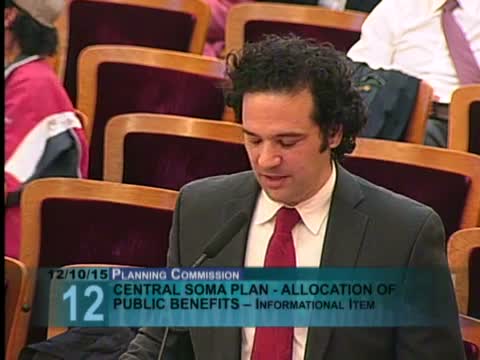
Project manager Steve Orthheim said staff estimates approximately $350 million in public benefits would be available under existing zoning but upzoning in the Central SoMa plan could increase that to about $2 billion, with an additional $1 billion in annual general‑fund revenue projected over the plan buildout. The department framed a set of "basic ingredients" — including a 33% affordable housing target tied to Prop K and existing impact fees — and five “entrees” that mix additional spending priorities such as transit, open space, historic preservation, PDR (production/distribution/repair) space and an eco‑district.
Orthheim told the commission the draft EIR is now expected in May and that more detailed nexus studies and a public survey will follow; staff plans targeted outreach and an online "menu" questionnaire. Commissioners and many community speakers asked for clearer phasing schedules, fiscal nexus tables that show how value capture relates to specific infrastructure needs, stronger community‑led alternatives and expanded language access for outreach. Several neighborhood and housing advocates urged that funding for transit and neighborhood infrastructure be prioritized and that the plan tie affordable housing delivery to market‑rate phasing. Staff said many of those issues would be examined in greater depth during the EIR and subsequent technical work.
The presentation was informational; staff asked for feedback to shape code and fee proposals ahead of later public hearings and the EIR process.