Get Full Government Meeting Transcripts, Videos, & Alerts Forever!
Get email alerts on the Affordable Housing Bonus Program topic
No spam. Unsubscribe anytime.
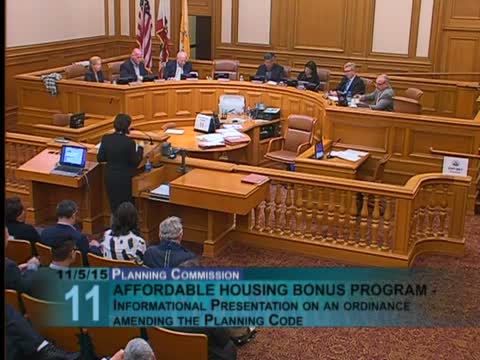
Commission hears months of neighborhood concerns over Affordable Housing Bonus Program; informational hearing continued to Jan. 28
Summary
The San Francisco Planning Commission on Nov. 5 heard hours of public testimony on a draft Affordable Housing Bonus Program that would let developers exceed some zoning limits in exchange for more on-site affordable units. Commissioners agreed to convert the previously scheduled Dec. 3 hearing into an informational session and continued final action to Jan. 28, 2016.
The San Francisco Planning Commission on Nov. 5 took another step in its months-long review of a draft Affordable Housing Bonus Program intended to encourage more on-site affordable and middle‑income housing by giving eligible projects additional height, density, and a limited menu of zoning incentives.
Commission staff outlined four paths in the proposal: a local program offering up to 30% on-site affordability (12% low/moderate and 18% middle income), a 100%‑affordable track with larger entitlements, a state‑analyzed implementation of California’s density bonus law, and an individually requested process for projects that fall outside the program’s parameters. Staff presented modeling by David Baker Architects and financial analysis by Libby Seifel that showed the local option could produce more inclusionary units and up to several thousand middle‑income units over multiple development cycles if broadly used.
Neighbors and neighborhood groups filled the public speakers list for the continuance and for the AHBP informational. Dozens of speakers from across the city — including representatives of the Coalition for San Francisco Neighborhoods, Sunset Parkside Education and Action Committee (SPEAK), the Planning Association for the Richmond and many individual residents — urged a longer delay to allow district‑level meetings, more thorough outreach and an environmental review. They warned the program as written could allow building footprints or rooftop decks that would cast new shadows and change neighborhood scale. Several speakers also urged stronger tenant protections and a binding “right to return” and one‑for‑one replacement where demolition would remove rent‑controlled units.
Affordable‑housing advocates, housing developers and workforce groups countered that the program is an important, largely market‑driven tool to produce permanently affordable and middle‑income housing without relying on new public subsidies. The mayor’s office and the Planning Department stressed the program grew out of recent housing studies and the mayor’s housing task force and that staff would continue outreach and refine draft language before any ordinance is finalized.
After extended debate, the commission voted to convert the December 3 date into an informational hearing and to continue final consideration of items 1 and 2 to Jan. 28, 2016. Commissioners said they wanted additional neighborhood outreach and technical clarifications — particularly on tenant protections, lot‑assembly rules, and the menu of allowable concessions — before a final vote.
What’s next: the Planning Department will refine the draft ordinance and a tenant‑protection package, continue district briefings and return to the Planning Commission on Jan. 28 for another public hearing; amendments to code and any Board of Supervisors actions would follow the commission’s recommendations.