Get Full Government Meeting Transcripts, Videos, & Alerts Forever!
Get email alerts on the Affordable Housing Bonus topic
No spam. Unsubscribe anytime.
Planning Commission initiates general plan amendments for Affordable Housing Bonus Program
Summary
The commission voted unanimously to initiate general plan amendments for a local Affordable Housing Bonus Program that offers state and local density-bonus options, aiming to increase affordable and middle-income housing; commissioners requested more detailed financial modeling, design guidance and neighborhood outreach before adoption.
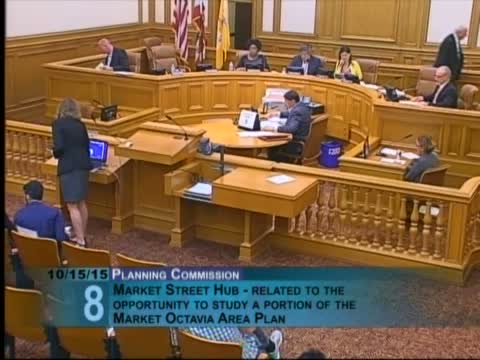
The San Francisco Planning Commission voted unanimously Oct. 15 to initiate general plan amendments for the Affordable Housing Bonus Program, the department—s package that lays out both state density-bonus and a more incentivized local program intended to produce higher levels of affordable and middle-income housing.
Jeff Buckley, senior advisor to Mayor Ed Lee on housing policy, framed the program as part of a broader city commitment to housing. “By 2020 the mayor is committed to committing 10,000 units for low and moderate income housing,” Buckley said, and staff urged the commission to initiate to align general plan amendments with upcoming legislation and public hearings.
Kiersten (Kirsten) Deissinger and Planning Department staff presented technical details: staff estimated roughly 240 soft sites across the program area over 20 years, scenario ranges from about 7,400 units under existing zoning to about 16,000 under local program assumptions, and a local program could generate substantially more inclusionary units and middle-income units than the state option.
Public commenters from neighborhood organizations urged slowing the timeline and improving neighborhood outreach, citing concerns about upzoning across broad areas, shadow impacts, loss of small businesses and displacement risks. Supporters including SPUR said the program is a necessary and thoughtful tool to meet the city—s housing needs and should move forward.
Commissioners debated incentives to encourage developers to select the local program over the state option, the treatment of off-site versus on-site inclusionary units (off-site units counted within a one-mile radius under current practice), protections against demolition of rent-controlled units (AB 2222 was discussed) and the need for more precise numbers on value capture and project typologies. Several commissioners asked staff to return with urban-design scenarios, financial feasibility analysis and clearer mapping of the 240 soft sites.
Commissioner Johnson moved to initiate the general plan amendments and to use Nov. 5 as an informational hearing; the motion was seconded and passed unanimously 5-0, starting the formal initiation process within the 90-day window after the legislation—s Sept. 29 introduction. Staff said it will return with additional analysis and outreach materials before any adoption vote.