Get Full Government Meeting Transcripts, Videos, & Alerts Forever!
Get email alerts on the Housing Preference topic
No spam. Unsubscribe anytime.
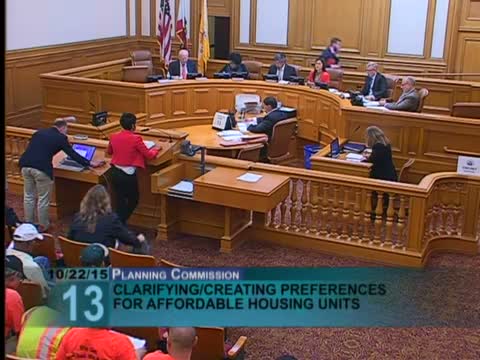
Commission backs 25% supervisorial geographic preference for new affordable units, splits displaced‑tenant proposal
Summary
The Planning Commission recommended that the Board of Supervisors adopt a geographic preference that reserves up to 25% of new affordable housing units for residents of the supervisorial district plus a half‑mile buffer; the commission voted to remove and develop the displaced‑tenant expansion as a separate ordinance after stakeholder outreach and further modeling.
The Planning Commission on Oct. 22 recommended that the Board of Supervisors adopt an ordinance creating a geographic housing preference that would reserve up to 25% of new affordable units for existing residents of a supervisorial district or those living within a half‑mile buffer of a project. Commissioners also voted to strip the proposed expansion of the displaced‑tenant preference from the same ordinance and asked staff and the Mayor’s Office of Housing and Community Development (MOHCD) to return with a separate, more fully vetted proposal.
Monica Mohan of Planning staff and Sophie Hayward of MOHCD presented the technical rationale for the recommendation, including modeling by Charles McNulty. MOHCD tested four alternative geographies and two preference percentages (25% and 50%) and used court‑informed disparate‑impact tests (a 4/5ths selection‑rate test and a standard deviation analysis) to evaluate fair‑housing risk. McNulty reported that a 25% preference at the supervisorial‑district level produced the fewest geographic subdivisions that would fail the tests; a 50% preference produced substantially more potential failures.
Public testimony was lengthy and mixed. Many community groups and supervisors supported the concept of neighborhood or local preference to help keep long‑time residents in place; several speakers from neighborhoods experiencing acute displacement (Bayview, Western Addition) pushed for higher percentages or smaller, tailored geographies. Supervisor London Breed said she supports increasing the percentage in some cases and asked staff to consider ways to cast a wide but effective net. Housing advocates and developers urged care to avoid legal risk that could slow production.
Commissioners discussed tradeoffs between local access and citywide equity, the operational complexity of current lottery systems, and the legal exposure of stronger preferences. Commissioners ultimately voted unanimously to recommend the geographic preference as proposed by staff (supervisorial district + half‑mile, 25% preference) and to refer the displaced‑tenant elements for further outreach and modeling. The commission also asked the Board to study smaller geographic boundary options and encouraged continued work to centralize lottery administration.
Next steps: Commission recommendation is forwarded to the Board of Supervisors with the staff modifications and an amendment to study smaller geographic boundaries. MOHCD will continue outreach and return with a separate displaced‑tenant proposal.