Get Full Government Meeting Transcripts, Videos, & Alerts Forever!
Get email alerts on the Environmental Review topic
No spam. Unsubscribe anytime.
Draft EIR for 901 Sixteenth / 1200 Seventeenth triggers debate over metal‑shed reuse versus dense housing
Summary
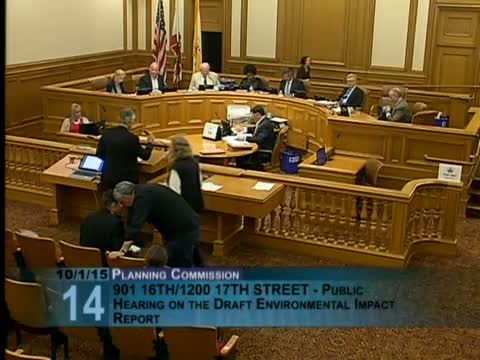
The Planning Commission heard extensive public comment on the draft EIR for the Coravin site, which would add about 395 units. The EIR identifies significant and unavoidable transportation impacts and loss of PDR; community groups pressed for the ‘metal shed’ adaptive reuse alternative to preserve industrial buildings and jobs, while the sponsor argued for the proposed dense mixed‑use outcome.
The Planning Department presented the draft Environmental Impact Report for a redevelopment of the Coravin site at 901 Sixteenth Street and 1200 Seventeenth Street. The sponsor’s preferred project would demolish two metal‑shed warehouses and other structures and construct two new residential buildings (a six‑story building on Sixteenth and a four‑story building on Seventeenth) totaling 395 dwelling units, roughly 25,000 square feet of commercial space, and an estimated 388 off‑street parking spaces.
The draft EIR concluded the project would cause significant and unavoidable transportation and circulation impacts at key intersections and that it would contribute to cumulative loss of production/distribution/repair (PDR) space identified in the Eastern Neighborhoods programmatic EIR. The EIR examined two mitigation alternatives: a reduced density alternative and a “metal‑shed reuse” alternative that would preserve and adapt warehouse sheds for maker/PDR uses plus a lower quantum of new housing.
Public commenters and preservationists urged adoption of the metal‑shed alternative, arguing the existing corrugated warehouses convey the neighborhood’s industrial history and provide flexible maker and light‑manufacturing space. Architectural historians and neighborhood advocates said the metal sheds are among the last such structures in the area and urged adaptive reuse that would retain PDR jobs and smaller‑scale yards and plazas.
Opponents also challenged the EIR’s traffic baseline and cumulative modeling, pointing to current congestion on Mariposa, Mississippi and the 280 ramps and arguing the report understates peak, event and multi‑project impacts (for example, arena/event traffic was raised by multiple speakers). Sponsor and some neighborhood supporters said the proposed project would activate a long‑vacant industrial block, provide new housing and retail, and is consistent with the Eastern Neighborhoods rezoning; the sponsor said preservation alternatives were considered but found infeasible in their current economic form.
The commission heard dozens of public speakers across the evening. Staff recorded that the public comment period for the draft EIR remains open through Oct. 5, 2015; staff will prepare and publish a response to comments and anticipate a final EIR and certification hearing in spring 2016. Commissioners asked staff to provide a more detailed justification for alternatives rejected as infeasible and to clarify traffic modeling parameters and baseline years in the comments and responses document.