Get Full Government Meeting Transcripts, Videos, & Alerts Forever!
Get email alerts on the Affordable Housing Preference topic
No spam. Unsubscribe anytime.
Commission debates expanded preference rules for affordable units; continuation set
Summary
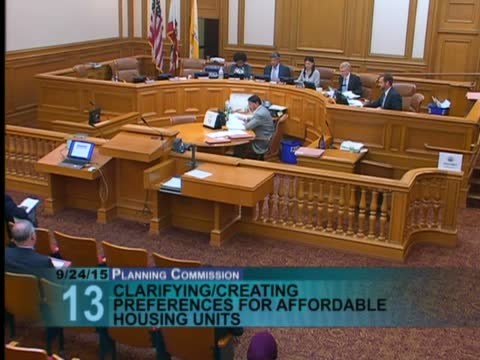
The Planning Commission and public heard a contentious presentation on proposed ordinance changes that expand displaced-tenant preferences and create a neighborhood preference (25%). After hours of testimony about fair-housing risk and operational details, the commission continued the measure for further analysis and outreach.
Planning staff and the Mayor—s Office of Housing and Community Development presented a proposed ordinance to consolidate and expand housing preferences on Sept. 24. The substitute proposal would keep the historical Certificate of Preference (COP) program intact, expand the displaced-tenant (Ellis/other no-fault) preference categories, and create a new neighborhood preference for a portion of units in new affordable developments.
Madika Mohan (Planning staff) explained the mechanics in the substitute language: the neighborhood preference would apply to 25% of units (after COP and displaced-tenant preferences); the displaced-tenant preference would be expanded to include all no-fault evictions, fires and expiring affordability restrictions; and the geography would be a supervisorial district plus a half-mile buffer. Sophie Hayward (MOHCD) said the substitute legislation would reserve half of the displaced-tenant preference for neighborhood residents displaced from the area and extend the look-back period to six years in some cases.
Public testimony was extensive and sharply divided. Tenant advocates and housing-rights organizations warned the commission that expanding the displaced-tenant preference broadly would create a large backlog of eligible households and produce a "false hope" without enough units. Several community groups urged a narrower, more targeted approach and asked for improved outreach and impact analysis. Other neighborhood and housing groups supported a neighborhood preference as a way to increase access for long-time residents.
Commissioners pressed staff on fair-housing risks, neighborhood definitions (supervisorial district vs. the Planning Department—s neighborhood map), implementation logistics and likely impacts on existing waiting lists. Planning staff said preliminary fair-housing modeling showed risks for very small neighborhood definitions and recommended discretion to aggregate neighborhoods where needed; MOHCD said it had run analyses and proposed safeguards (limiting neighborhood share to 25%).
After debate, the commission voted 6-1 to continue the item to Oct. 22 for further analysis and staff outreach, directing Planning and MOHCD to provide additional data on geography alternatives, fair-housing analysis and implementation details for how a neighborhood preference would operate alongside the displaced-tenant preference.