Get Full Government Meeting Transcripts, Videos, & Alerts Forever!
Get email alerts on the Housing Policy topic
No spam. Unsubscribe anytime.
Planning staff and MOHCD outline portfolio, bonus program and small-sites push
Summary
Planning Department and the Mayor—s Office of Housing and Community Development briefed the Planning Commission on ongoing preservation and production efforts, previewed an affordable-housing bonus program and described small-sites and down-payment programs as part of a multi-track strategy to add and preserve roughly 10,000 permanently affordable units by 2020.
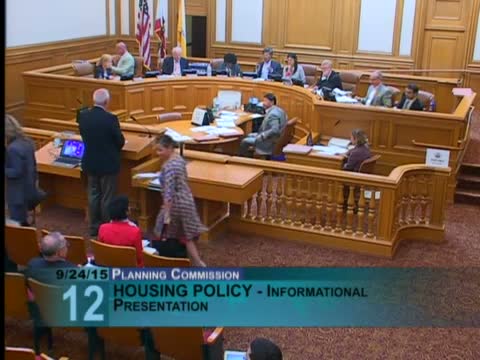
Planning Department staff and officials from the Mayor—s Office of Housing and Community Development (MOHCD) presented an informational briefing to the Planning Commission on Sept. 24, outlining the city—s housing portfolio, preservation tools and a proposed local affordable-housing bonus program.
Gil Kelley, Director of Citywide Planning, framed the session as follow-up to a spring conversation about equity and long-term demographic change. He told the commission the department would pursue both production of new units and preservation of the existing affordable stock.
Kirsten Dissinger and Sophie Hayward of MOHCD walked commissioners through the agency—s programs and funding sources. Hayward said MOHCD currently manages roughly 21,000 regulated affordable units and that the agency is pursuing a mix of strategies: 100% affordable construction, small-sites acquisition and rehab, preservation tools for expiring subsidies and expanded down-payment assistance. "We will preserve a minimum of 1,435 existing units and build 4,500 new units," Hayward said in the presentation materials, while noting staff would provide updated counts for some portfolio figures.
MOHCD described a proposed local affordable-housing bonus to augment the state's density bonus law. Planning staff said the draft local program would offer two paths: one that aligns closely with state law and a second that would provide stronger city incentives tied to local goals, including middle-income units and higher on-site affordability. The department urged public review and scheduled outreach, including an open house at City Hall on Oct. 26 and a webinar for Oct. 22.
The presentation also described MOHCD financing: a conservative estimate of about $2.5 billion in housing investment over the next 20 years, drawing on impact fees, a local housing trust fund and state and federal sources. Staff warned the estimate is sensitive to economic cycles and federal funding availability.
Commissioners and public speakers pressed staff on program details: how many households each program serves, how preservation counts are tallied, and whether acquisition programs could be scaled to meet urgent displacement risks. Commissioners asked MOHCD to return with clearer, updated unit counts and with more information about outreach and program mechanics for the proposed bonus, particularly sample site-based illustrations that show how the bonus works in practice.
MOHCD said it would provide the commission with more detailed fiscal and program materials and continue community outreach before any ordinance is filed.