Get Full Government Meeting Transcripts, Videos, & Alerts Forever!
Get email alerts on the Housing Balance topic
No spam. Unsubscribe anytime.
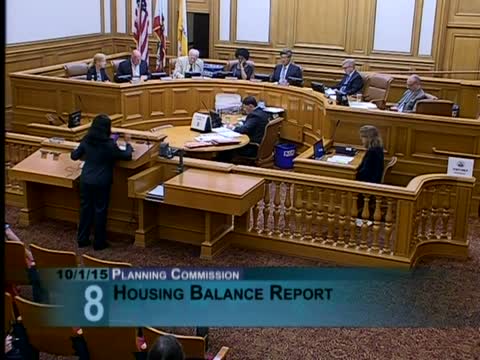
Planning Commission hears housing‑balance report showing citywide balance at about 15% affordable
Summary
Planning Department staff told the commission the city’s new Housing Balance Report finds roughly 4,900 net affordable units over the most recent 10‑year window — about 15% of net new units — far short of Proposition K and RHNA targets. Commissioners debated counting pipeline mega‑projects and preserving existing units lost by demolition or owner move‑ins.
Teresa Ojeda, senior planner for the Department of Citywide Policy Planning, presented the Planning Department’s second biannual Housing Balance Report, which covers the period through the second quarter of 2015. The report calculates the city’s “net affordable housing stock” at 4,900 units and the 10‑year cumulative housing balance at about 15% affordable, short of the city goals cited in Proposition K (32% or 33% target in local debate) and far below state RHNA allocations, Ojeda said.
The report defines the housing balance as affordable units (from new construction, acquisitions and rehabs, RAD replacements) divided by net new units over a 10‑year period. It also counts losses from rent‑control removals, Ellis Act exits, demolitions and condo conversions as units “removed from protected status,” which reduces the net affordable stock. The department’s projected near‑term pipeline balance was shown at about 13%.
Advocates and commissioners framed the figure as an alarm. Peter Cohen of the Council of Community Housing Organizations called the results “stunning” and pressed the commission to take preservation as seriously as production: “It’s 15% affordable,” he said, arguing that the city cannot simply build its way out of affordability shortfalls. Cohen and others highlighted that losses of existing rent‑restricted units remain a major driver of the shortfall.
Commissioners pressed staff for more detail about how large entitled projects (for example, Treasure Island, Hunters Point and Park Merced) factor into ongoing projections. Some commissioners said excluding large master‑plan projects from the near‑term projected balance understates the city’s likely future affordable production; others said treating those projects as hypothetical inflates forecasts because entitlement, infrastructure and phasing are uncertain.
Several commissioners asked staff for more granular materials: maps showing where balances are negative (by planning district and Board of Supervisors district), clearer separations of ‘‘production’’ versus ‘‘net’’ balances, and a projection ledger that layers pipeline unit deliveries against open‑space and transportation investments. Ojeda said the ordinance requires continued biannual reporting, and staff will present the next updates and an institutional hearing before the Board of Supervisors as scheduled.
Next steps: the department will keep the biannual schedule (March 1 and Sept. 1), present the report at the Board of Supervisors as required, and supply more district‑level breakdowns on the Commission’s request. The commission indicated it will use the monitoring report in upcoming policy and legislative items on affordability and displacement.