Get Full Government Meeting Transcripts, Videos, & Alerts Forever!
Get email alerts on the Transportation topic
No spam. Unsubscribe anytime.
Planning Commission backs citywide Transportation Sustainability Fee with amendments
Summary
The Planning Commission recommended approval of a new Transportation Sustainability Fee to raise funds for Muni, complete-streets and regional transit, adopting several amendments including graduated grandfathering and a request that the Board consider higher rates in some areas. The Commission vote was unanimous.
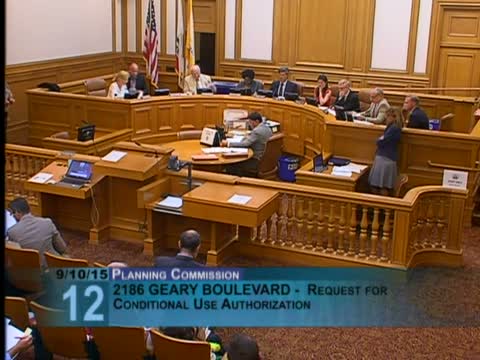
The San Francisco Planning Commission on Sept. 10 recommended that the Board of Supervisors adopt a citywide Transportation Sustainability Fee (TSF) designed to expand and replace the existing Transit Impact Development Fee and generate funding for transit capacity, vehicle expansion and complete‑streets projects.
Planning staff presented the TSF as part of a three‑part transportation sustainability program. Lisa Chen of the Planning Department said the proposal would create the city’s first residential transportation impact fee and apply a fee to many additional uses; staff estimated the program would raise approximately $1.2 billion over time, including about $400 million in net new revenue. Tilly Chang, executive director of the San Francisco County Transportation Authority, told commissioners the agency was “strongly supportive” of the proposal and the collaborative work that produced it.
Alicia John‑Baptiste of the San Francisco Municipal Transportation Agency said the revised fee structure would generate roughly $38 million a year in new revenue under the current proposal and that funding would be split so about 60% would replace existing TIDF uses (preventive maintenance and smaller capital/maintenance items) while the balance would be programmed for capacity expansion and bicycle and pedestrian projects.
Public testimony came from a broad coalition of transit, bicycle and housing advocates as well as representatives of universities and hospitals. Speakers generally supported a fee that asks developers to contribute toward transportation needs but many urged higher rates and narrower waivers. Several speakers — including the San Francisco Transit Riders Union, Walk San Francisco and the Bicycle Coalition — urged the Commission to consider moving the proposed rates closer to the legal nexus identified in staff studies, while university representatives requested the charitable exemption be retained for certain institutional master‑plan projects.
Commission debate focused on a set of technical and policy choices: whether hospitals and large post‑secondary institutions should be exempted, how to treat projects already in the pipeline (grandfathering), whether parking square footage should be included, and whether rates should vary by neighborhood to reflect differing market feasibility. Commissioners also discussed the need to periodically update the economic feasibility study that underpins the proposed rates.
The Commission voted to recommend approval with amendments. Key modifications captured in the Commission motion include a graduated grandfathering approach (reduced fee reductions for projects that filed applications after a set date), asking the Board of Supervisors to consider a graduated TSF that could reach up to one‑third (33%) of the maximum nexus amount in certain neighborhoods where feasibility permits, clarifying treatment of middle‑income exemptions, and directing that the economic feasibility analysis be revisited on a three‑year cycle or sooner on request. The motion passed unanimously.
What’s next: The Planning Commission’s recommendation will be forwarded to the Board of Supervisors, which has the authority to adopt, reject or modify the proposed ordinance and the Commission’s suggested amendments.