Get Full Government Meeting Transcripts, Videos, & Alerts Forever!
Get email alerts on the Environmental Review topic
No spam. Unsubscribe anytime.
Planning Commission certifies final EIR for 800 Indiana despite historic‑resource impact
Summary
The Planning Commission voted unanimously to certify the final environmental impact report for the proposed 800 Indiana Street development, after staff found a "significant unavoidable impact" to an historic resource and said a Statement of Overriding Considerations would be required if the project moves forward.
The San Francisco Planning Commission on Nov. 20 certified the final environmental impact report for the 800 Indiana Street mixed‑use development, finding that demolition of the existing industrial warehouse would cause a "significant unavoidable impact" to an historic architectural resource.
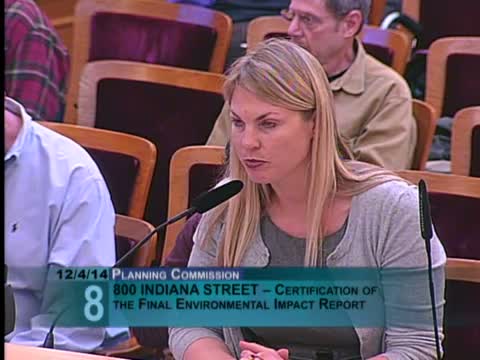
Rachel Sheit, Planning Department project lead, told the commission the final EIR and responses to comments conclude that demolition would cause an impact that "could not be mitigated to a less than significant level," and that approving the project would therefore require adoption of a Statement of Overriding Considerations under the California Environmental Quality Act. "The evaluation of the issues contained in the EIR found that implementation of the proposed project would result in a significant unavoidable impact to an historic resource," Sheit said.
The report, staff said, includes a revised mitigation measure to place a permanent interpretive display in a publicly accessible outdoor plaza on the project site rather than inside the lobby. Planning staff also reported that public comments raised concerns about construction‑period noise, air quality and traffic circulation; responses to comments provided clarification but did not change the environmental conclusions.
Labor and housing advocates addressed the commission during public comment. Danny Campbell of Sheet Metal Workers Local 104 said the union "supports this EIR" and looks forward to certification. Rob Pool of the Housing Action Coalition said the project would transform an underused site into transit‑served housing and public space.
Commissioner Antonini moved to certify the final EIR. The motion passed 7‑0.
What happens next: certification allows the city to consider project approvals, but staff said the Planning Commission must adopt the Statement of Overriding Considerations if it ultimately votes to approve the project, because the EIR identifies an unavoidable historic‑resource impact. The planning staff also noted the responses to comments and the draft certification motion are part of the administrative record supporting certification.
Key documents and legal basis: planning staff said the final EIR consists of the draft EIR published on Aug. 13, 2014, plus a Responses to Comments document distributed Nov. 5; staff cited CEQA, CEQA Guidelines and Chapter 31 of the Administrative Code in framing the certification request.