Get Full Government Meeting Transcripts, Videos, & Alerts Forever!
Get email alerts on the Mission Housing Controls topic
No spam. Unsubscribe anytime.
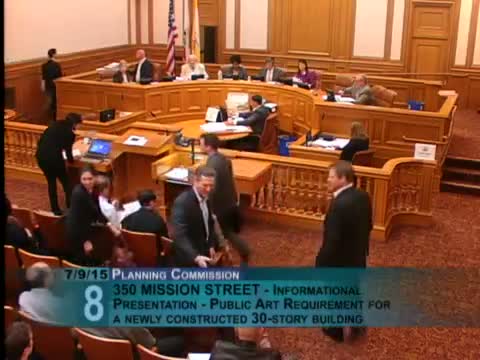
Planning Commission initiates Mission interim controls after hours of debate and public comment
Summary
After hours of public testimony for and against, the San Francisco Planning Commission voted 5–1 to initiate a package of interim planning controls for the Mission District and to schedule an informational hearing July 23 with a potential adoption hearing Aug. 6. The move begins a six‑month pause intended to analyze displacement and site opportunities.
The San Francisco Planning Commission voted 5–1 on July 9 to initiate interim planning controls aimed at stemming resident and business displacement in the Mission District while staff develops a broader Mission Action Plan 2020.
The motion, moved by Commissioner Richards and seconded by another commissioner, schedules an informational hearing for July 23 and a possible adoption hearing for Aug. 6. Commissioner Antonini cast the lone no vote, saying she did not see an emergency that justified the initiation as proposed.
Planning Department staff outlined why controls are being considered, citing data presented by Claudia Flores of planning staff showing that between 2009 and 2013 roughly 150 households a year earning 30–120 percent of area median income left the Mission, eviction notices rose sharply and the Latino share of the neighborhood fell from roughly one‑half to about 38.5 percent by 2013. Flores said the interim controls are intended to ‘‘provide time to analyze affordable housing needs, assess sites for affordable housing production, stem the loss of income‑protected units, and maintain PDR capacity in PDR lands, and preserve vital community resources.’’
Public testimony filled much of the meeting. Housing advocates including Tim Cohen of the San Francisco Housing Action Coalition supported initiating the process but urged the city also accelerate production of affordable housing and to protect projects already in the pipeline. ‘‘We very much want to see more affordable housing built in the Mission,’’ Cohen said.
Community groups and tenants repeatedly asked for a full moratorium rather than the staff proposal, arguing the draft geography and grandfathering date left key projects — including two large, controversial proposals — outside the controls. Plaza 16 Coalition and Mission SRO Collaborative speakers pressed commissioners to take stronger action and to include the highest‑priority pipeline projects. Developers, labor and business representatives warned that overly broad or retroactive restrictions could derail projects that have already paid fees and invested years in the entitlement process; Intermission SF and others told commissioners some projects include partnerships to relocate and subsidize arts and PDR uses.
Commissioners discussed several thresholds for what the controls should cover — a filing date (staff proposed Jan. 1, 2015), project size, whether vacant lots should be exempt, and whether displacement of existing tenants or businesses should be the key trigger. City Attorney Kate Stacy reminded commissioners of legal limits, including how interim controls relate to pending ballot measures. Commissioners agreed to use the six‑month interim period to develop complementary measures such as eviction control strategies, small‑sites acquisition and an affordable housing nexus analysis.
The initiation does not adopt specific permanent rules; it opens the public record and directs staff to develop final language. Flores and Director Ram told the commission staff will work with community groups, the mayor’s office and other agencies to produce an integrated set of protections and production strategies during the six‑month period.