Get Full Government Meeting Transcripts, Videos, & Alerts Forever!
Get email alerts on the Development Approvals topic
No spam. Unsubscribe anytime.
Planning commission approves three reuse and infill items, and a Dogpatch medical‑cannabis shop with conditions
Summary
The commission approved adaptive‑reuse and infill projects at 811 Treat and 1238 Sutter (with a 13‑foot front setback), granted a variance and conditions for 811 Treat, and approved a Dogpatch medical‑cannabis dispensary at 2544 Third Street with a 6‑month operational review.
At its May 7 meeting the San Francisco Planning Commission cleared several items on the regular calendar, approving adaptive‑reuse and infill projects and placing conditions on final plans.
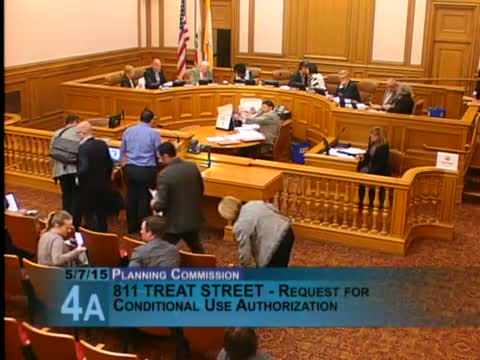
The commission unanimously approved a conditional‑use authorization and variance for a conversion at 811 Treat Avenue, allowing the sponsor to convert an existing rear storage building into two family‑sized dwelling units while eliminating a curb cut and adding bicycle parking and street trees. Staff recommended approval based on public benefits and sensitivity to the site’s historic context.
On 1238 Sutter Street, a proposed nine‑story, 37‑unit building in the Van Ness Special Use District was approved after the sponsor modified the design to preserve an existing brick facade and improve Fern Street frontage. Commissioners endorsed a compromise to keep a contextual lower‑floor treatment and adopted a minimum 13‑foot front setback on Sutter Street to avoid the appearance of a historic facade pasted onto a modern tower; the zoning administrator will hold variance decisions until final revised plans are filed.
The commission also took up a mandatory discretionary review for a proposed medical‑cannabis dispensary, Dogpatch Collective, at 2544 Third Street. Staff reported letters both supporting and opposing the project and confirmed the site was more than 1,000 feet from primary and secondary schools. Sponsor Robert Watson emphasized testing, organic standards and community outreach. The commission approved the application but added conditions including indoor security (no guarding on the sidewalk) and required a staff memo on operations and complaints after six months.
These approvals reflect the commission’s continued efforts to balance new housing production, neighborhood character and community impacts while using conditions of approval to resolve design and operational concerns.