Get Full Government Meeting Transcripts, Videos, & Alerts Forever!
Get email alerts on the Waste Management topic
No spam. Unsubscribe anytime.
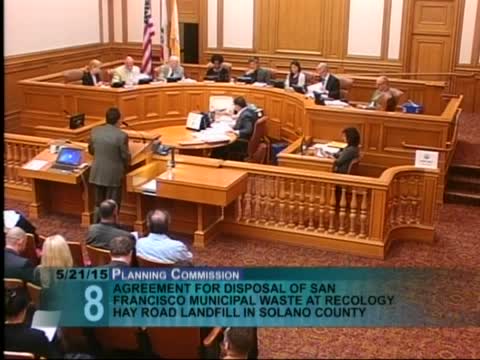
Planning commission upholds department's negative declaration for hauling city waste to Recology Hay Road landfill
Summary
After contested appeals, the San Francisco Planning Commission unanimously upheld the planning department's preliminary negative declaration for a proposed agreement to send municipal solid waste to the Recology Hay Road landfill in Solano County, finding no substantial evidence of significant impacts under CEQA.
The San Francisco Planning Commission on May 21 upheld the planning department's preliminary negative declaration for an agreement to haul the city's municipal solid waste to the Recology Hay Road landfill in Solano County, a decision the commission approved unanimously.
The decision centered on environmental analysis under the California Environmental Quality Act. Planning staff argued the project involves no physical change within San Francisco and that the increment in truck trips and emissions relative to the existing baseline (hauling to Altamont) would not exceed thresholds of significance. "Our initial study shows that the project does not have significant impacts, and that's why we published the negative declaration," staff planner Paul Malcher told commissioners during the presentation.
Appellants, led by Duane Cromm and counsel Josh Levine representing the Solano County Orderly Growth Committee, said the scale of the contract and the additional round-trip mileage (about 40 miles more per truck) provided a fair argument for significant air-quality and traffic impacts and warranted a full environmental impact report. "We request that you reject the preliminary negative declaration and require a complete environmental analysis of this project," Duane Cromm said during public testimony.
Planning staff and the project sponsor disputed those claims. Jack Macy of the Department of the Environment said the planning department's numbers are conservative: the negative declaration used 50 truck trips per day, which the department described as a conservative estimate, and staff noted the Solano landfill is currently operating well under permitted capacity. Macy also told the commission that the city is implementing waste diversion programs and technology upgrades that are expected to reduce tonnage to landfill over the contract term.
Commissioners questioned staff on the air-quality modeling and the thresholds used. Staff walked the commission through emissions tables in the negative declaration showing criteria pollutants and project totals under the adopted thresholds. After discussion, a commissioner moved to uphold the negative declaration. The motion passed unanimously, sustaining the planning department's CEQA determination that the proposed change in disposal location would not have significant environmental impacts under the scope analyzed.
The ruling applies only to the CEQA determination; any final approval of contracts or operational agreements remains with the Department of the Environment and the Board of Supervisors.
What happens next: The department may proceed with the administrative steps toward contract approval, subject to any further legislative or Board of Supervisors review. The commission's action was strictly on whether the published negative declaration was supported by substantial evidence under CEQA.