Get Full Government Meeting Transcripts, Videos, & Alerts Forever!
Get email alerts on the Market Octavia Unit Mix topic
No spam. Unsubscribe anytime.
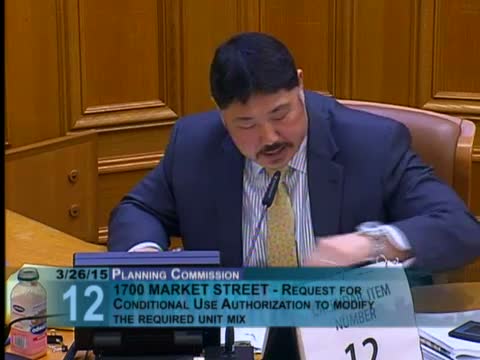
Commission continues debate over 1700 Market unit mix after community pushback
Summary
A developer sought to replace the Market/Octavia 40% two‑bedroom requirement with a mostly studio/one‑bed scheme for an irregular gore lot; neighbors and Hayes Valley groups urged keeping family‑size unit requirements and on‑site affordable family housing. The commission voted 4–3 to continue the item to April 23 for more information.
Developers and planners clashed with neighborhood groups on Friday over whether an irregular gore lot at 1700 Market Street should be granted a conditional‑use waiver of the Market/Octavia requirement that 40% of new units be two‑bedrooms.
Planning staff recommended approval of a 48‑unit proposal made up largely of studios and one‑bedrooms, citing the site’s unusual triangular geometry and the Market/Octavia code provision that allows flexibility for small irregular lots. "This project is constrained by lot geometry and circulation demands," Planning staff said in their presentation. The sponsor confirmed that the smaller units make the project economically feasible on the site.
Opposition came from a cross section of neighborhood organizations and the supervisor’s office. April Veneracion, a legislative aide for Supervisor Jane Kim, told the commission the two‑bedroom mix is an important plan‑level safeguard that helps keep family housing in the area. The Hayes Valley Neighborhood Association and the Council of Community Housing Organizations warned that granting an exception on policy grounds could set a damaging precedent for family housing in Market/Octavia and adjacent neighborhoods.
Housing advocates including the San Francisco Housing Action Coalition supported the project as an incremental source of units in a transit‑rich corridor and noted that the developer proposed an off‑site inclusionary contribution (payment to the city affordable‑housing fund) in lieu of on‑site family units. The sponsor told the commission that on this very small triangular parcel, fitting conventional two‑bedroom units would significantly reduce unit yield; planning staff estimated a compliant scheme would yield far fewer units.
Commissioners were divided. Some said the Market/Octavia 40% requirement is a plan‑level protection for family housing that should be preserved except in the most unusual cases; others highlighted housing production and the site’s uniqueness. After extended public comment and questions about on‑site vs. off‑site affordable requirements, shadow and design compliance, and enforcement, the commission voted 4–3 to continue the hearing to April 23. The continuance asks the sponsor to explore whether a modest number of two‑bedroom units or increased common space is physically feasible and to clarify the in‑lieu fee calculation and any Costa‑Hawkins related agreements.
Outlook: The continuation gives the sponsor time to present alternative unit mixes and the commission time to weigh plan consistency against added units on a constrained site; the community has signaled it will press for on‑site family units or stronger guarantees if an exception is granted.