Get Full Government Meeting Transcripts, Videos, & Alerts Forever!
Get email alerts on the Massage Regulation topic
No spam. Unsubscribe anytime.
San Francisco officials propose tighter regulation of massage businesses, citing trafficking concerns
Summary
Supervisor Katie Tang and the Department of Public Health urged restoring local land‑use control and licensing for massage establishments to close regulatory gaps that they say have enabled illicit operations; business groups, sole practitioners and the Small Business Commission pressed for exemptions and amnesty.
Supervisor Katie Tang and public‑health officials on Friday proposed a pair of city ordinances that would restore local land‑use control over massage establishments and strengthen Department of Public Health (DPH) permitting and enforcement.
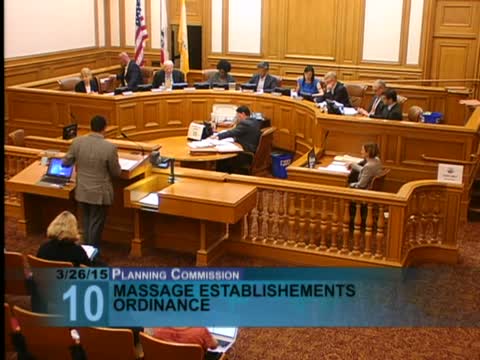
At the Planning Commission hearing, Tang said recent state law (AB 1147) returned land‑use authority to cities and the two‑part package — a health‑code amendment and a planning‑code amendment — would require establishment permits from DPH even for operators who qualify for a California Massage Therapy Council (CAMTC) exemption. "Most of what we're trying to do codifies what AB 1147 did," Tang said, framing the changes as a return to local oversight enacted in 2006.
Cindy Commerford of DPH told commissioners the department regulates roughly 240 massage establishments; she said about 90 currently claim state CAMTC exemptions and that the department has found "an estimated 30 to 50% of the massage establishments are illicit," describing problems inspectors encounter, including unsanitary conditions and signs that establishments are hubs for trafficking. Commerford said the code changes would delete the exemption that lets CAMTC‑exempt businesses avoid local permitting, extend the ability to revoke permits, and allow the city to bar re‑establishment at an address for a period after a closure for violations.
Planning staff outlined three land‑use changes: eliminating the conditional‑use exemption for CAMTC‑exempt establishments; barring re‑establishment at addresses shut for code violations for one year (the supervisor and stakeholders discussed amending that to three years); and no longer classifying CAMTC‑only establishments as medical‑service uses that generally avoid conditional‑use review. Diego Sanchez of Planning said the changes would reinstate neighborhood notification, public hearings and conditions of approval, all tools planners say can mitigate clustering and neighborhood impacts.
Industry speakers and sole practitioners pushed back. Adam Gordon, who said he employs 25 therapists in three city locations, called conditional‑use review "highly onerous" and said it risks forcing small independent operators out of business. London Elise and other sole practitioners argued for an exemption for single‑practitioner operators; the Planning Department and Supervisor Tang said they support exempting sole practitioners limited to one room or one table. Several speakers from trade schools and the San Francisco School of Massage emphasized the training requirements for CAMTC certification and urged the city to avoid measures that would unduly burden legitimate businesses.
The Small Business Commission representative and other commissioners urged an amnesty program and expedited procedures for small operators; Tang and Planning staff said they are working on an amnesty and an expedited track for sole practitioners and small establishments. Tang said the city proposes requiring DPH establishment permits for existing operators so the city can track and, if necessary, revoke permits.
No final vote was taken at the Planning Commission; commissioners and staff discussed refining the ordinance language, the scope of any amnesty, and how to define and enforce a sole‑practitioner exemption. Commissioner comments showed broad support for the goals of protecting neighborhoods and addressing trafficking while pressing staff to limit burdens on small legitimate businesses. The ordinance will return to the commission for further review and possible recommendation to the Board of Supervisors.
Outlook: The proposal would increase DPH authority and restore conditional‑use review for many existing businesses. Tang and DPH officials said the measures are intended to improve public‑health enforcement and neighborhood transparency; business groups asked planners for an expedited, lower‑cost track for small operators. The commission will consider amended language and implementation details before making a formal recommendation.