Get Full Government Meeting Transcripts, Videos, & Alerts Forever!
Get email alerts on the Housing Inventory topic
No spam. Unsubscribe anytime.
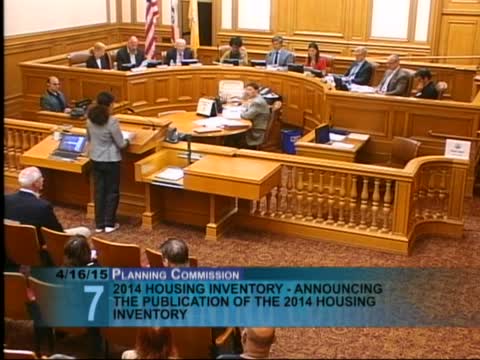
Planning Commission hears 2014 housing inventory; public urges tracking short‑term rental losses
Summary
Planning Department presented the 2014 Housing Inventory showing a net gain of 3,514 units and nearly $30 million in inclusionary fees collected. Public commenters and commissioners urged the department to track losses—especially short‑term rental conversions—and to put production figures in context with affordability targets.
The San Francisco Planning Commission on April 16 heard the department's annual 2014 Housing Inventory, which reported a net gain of 3,514 housing units and about $30 million in inclusionary fees collected in 2014.
The inventory, presented by Audrey Desmuec of the Planning Department, said the city's housing stock stood at roughly 39,390 units at the end of 2014. New construction and conversions produced the net gain, and the Department of Building Inspection permitted 3,834 units for construction in 2014. Inclusionary fees collected in 2014 were nearly $30 million, the largest single‑year total since 2008.
Why the numbers matter, the commission heard, is how production aligns with who lives here and what San Francisco needs. "Market‑rate production drives demand for more moderate and low income units," said Paul Wormer during public comment, urging the department to place inventory figures in the context of induced demand. Peter Cohen of the Council of Community Housing Organizations warned that although market‑rate production met or exceeded its targets, the city remains far short in producing moderate‑ and low‑income housing.
Several speakers asked the department to begin counting conversions to short‑term rentals as permanent unit losses. "The rough data indicates we're north of 10,000 units converted," said Calvin Moats, urging the city to demand reporting from web‑based hosts. Planning staff acknowledged the public's concerns and said the commission will take a follow‑up, more policy‑focused agenda item on May 14 to dig into the implications of the inventory and how it aligns with RHNA and local goals.
Commissioners pressed staff for additional breakdowns, including unit mix by neighborhood and age, vacancy and turnover rates, and a clearer accounting of entitled versus built units. Sophie Hayward from the Mayor's Office of Housing told commissioners that inclusionary fees are a key funding source for the city's 100% affordable pipeline and that the office is working on incentives to make off‑site inclusionary units more usable and better targeted.
The department treated the presentation as informational; no action was required. Staff said raw data tables and the full report are available online and in the Planning Department starting April 22.