Get Full Government Meeting Transcripts, Videos, & Alerts Forever!
Get email alerts on the Nightlife Protection topic
No spam. Unsubscribe anytime.
Planning Commission backs outreach ordinance to protect nightlife venues from nearby housing
Summary
The commission recommended approval of legislation requiring developers to notify the Entertainment Commission and nearby venues when building residential projects within 300 feet of permitted entertainment venues, and to record notice of special restrictions for future buyers/tenants; the recommendation passed unanimously.
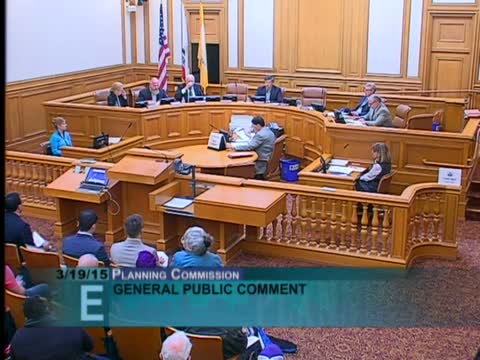
The San Francisco Planning Commission on March 19 recommended approval of an ordinance designed to reduce conflicts between new residential development and existing entertainment venues.
Diego Sanchez of the Planning Department presented the proposal, which would require the department to notify the Entertainment Commission and affected venues when a residential project is proposed within 300 feet of an existing permitted place of entertainment. Connor Johnson of Supervisor London Breed’s office and Jocelyn Kane of the Entertainment Commission outlined the ordinance’s three core elements: a map and registry of roughly 350 permitted venues, a front‑loaded outreach/hearing process in which the Entertainment Commission may convene a meeting between a developer and a venue, and a notice of special restrictions (NSR) recorded on property transfers disclosing proximity to venues.
Supporters including venue owners, the California Music and Culture Association and dozens of individual operators urged the commission to act to preserve San Francisco’s music ecosystem. Michael Winger of the Recording Academy and operators from The Independent, DNA Lounge and Bottom of the Hill described how noise complaints and subsequent enforcement or expensive sound remediation can force long‑standing venues to curtail operations or close. Venue representatives praised provisions that bar finding a venue a legal nuisance if it is operating within its permit terms and that require sellers or landlords to disclose proximity to venues to future residents.
Planning staff recommended refinements: narrow the set of projects subject to the outreach to larger projects (PPA, pre‑application meeting triggers and conversions to residential), require outreach prior to formal application, and shorten the response timelines for the Entertainment Commission to reduce review time. Commissioners asked whether projects already in the pipeline would be covered; staff explained building permits already issued would be exempt but conditional use applications and other cases may be subject to the ordinance. The ordinance also adds Planning Code section 3.14 to require the Planning Commission to consider Entertainment Commission input on compatibility.
Commissioners praised the front‑loaded approach as commonsense and supportive of both housing and nightlife; several suggested stronger real‑estate disclosure enforcement and monitoring. The commission moved to recommend approval with staff modifications; the motion passed unanimously 6‑0.
The recommendation will go to the Board of Supervisors and other bodies for subsequent action. The ordinance’s implementation will involve the Planning Department, the Entertainment Commission and the Department of Building Inspection.