Get Full Government Meeting Transcripts, Videos, & Alerts Forever!
Get email alerts on the Homeless Shelters topic
No spam. Unsubscribe anytime.
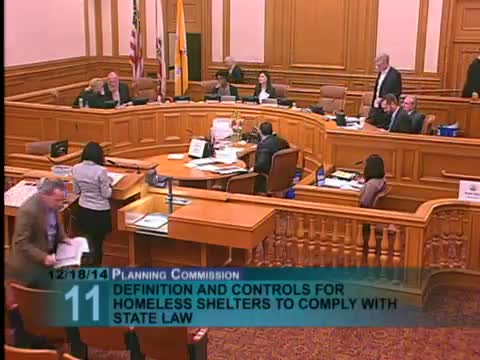
Planning commission backs ordinance to define and allow homeless shelters as‑of‑right in some zones
Summary
The commission unanimously recommended a Mayor‑sponsored Planning Code amendment to define 'homeless shelters,' allow them as‑of‑right in specified districts, exempt certain parking/open‑space/impact fees and apply 'good neighbor' policies; supporters said the change is needed to comply with state law and expand local capacity.
The Planning Department introduced an ordinance sponsored by Mayor Lee to amend Planning Code definitions and controls for homeless shelters so the code complies with state law requiring emergency shelters to be allowed as‑of‑right in at least one zoning district. Staff (Kimi Ahara) said the ordinance creates a new definition based on modern shelter operations, allows shelters as‑of‑right in certain zoning districts or with conditional approval in others, and exempts shelters from specific open‑space, parking and impact fee requirements because residents typically do not own vehicles.
Bevan Dufty of the Mayor’s Office of Housing and Opportunity presented the policy rationale and highlighted recent city efforts to reduce homelessness, increase permanent supportive housing and expand shelter access, saying temporary shelters remain a core part of the system for people awaiting housing placements. Public commenters from Glide, Mother Brown’s, homeless‑service providers and neighborhood groups urged approval, noting long shelter reservation lists and preventable deaths among people living on the street.
The Commission voted unanimously 7–0 to recommend approval to the Board of Supervisors. Commissioners and staff noted that implementing the ordinance would be accompanied by good‑neighbor requirements and continued interagency coordination; City departments will work out technical building and operational issues and community notification practices in follow‑up implementation.