Get Full Government Meeting Transcripts, Videos, & Alerts Forever!
Get email alerts on the Urban Forest topic
No spam. Unsubscribe anytime.
Commission continues Urban Forest Master Plan to allow technical fixes after debate over canopy definition and financing
Summary
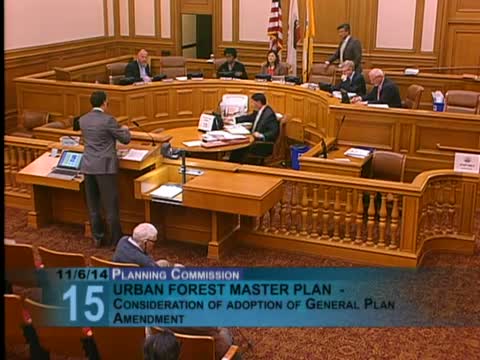
After hours of public comment split over whether the plan should count understory vegetation as part of the 'urban forest,' the Planning Commission voted 5–2 to continue the Urban Forest Plan Phase 1 (street trees) to Nov. 20 for glossary clarifications and a supplemental financing memo.
The Planning Commission took up the first-phase Urban Forest Master Plan (street trees), which recommends planting 50,000 new street trees over 20 years and establishing a funded street‑tree maintenance program.
Planning staff (John Sui) said Phase 1 focuses on street trees and that later phases will address parks and private trees. The plan proposes policy changes and funding ideas, and staff presented an accompanying AECOM analysis of possible financing mechanisms.
Public comment sharply divided. Opponents urged the plan be amended to retain a citywide canopy goal and to remove wording that counts "other vegetation" or 8‑foot shrubs as part of the urban forest. One speaker said the citywide canopy was 13.7% and declining and warned that counting shrubs would mask a failure to increase true tree canopy. Supporters — including Friends of the Urban Forest — urged adoption to establish a funded pathway for more street trees and noted the plan’s deliberate first-phase focus on street trees and a stretch goal of increasing street-tree numbers by 50%.
Commissioners debated definitional clarity and implementation: several asked for a glossary defining "street tree," "tree canopy," and "other vegetation," and asked staff for a supplemental memo that better separates property-based financing mechanisms from non–property-based options. Deputy City Attorney Marlena Burn advised that once the Commission forwards a General Plan amendment to the Board of Supervisors the Board can only accept or reject the package; line edits must be concrete at this hearing or the item needs to be continued.
On a 5–2 vote the Commission continued the item to November 20, directing staff to provide (1) a glossary/definitions clarifying the use of "trees" versus "other vegetation" where relevant, and (2) a secondary memo summarizing and expanding the analysis of property-based versus non–property-based financing options. Commissioners Richards and Hillis voted to continue earlier in the meeting but a separate attempt to postpone failed 3–4; the final continuation passed 5–2.