Get Full Government Meeting Transcripts, Videos, & Alerts Forever!
Get email alerts on the Code Enforcement Str topic
No spam. Unsubscribe anytime.
Commissions and public warn short‑term rental legalization and conversions will strain enforcement
Summary
Public commenters and commissioners urged Planning and DBI to clarify enforcement authority, staffing and tools before potential legalization of short‑term rentals and amid widespread unpermitted conversions; staff described a municipal registry, evidence standards and a one‑year review but warned enforcement will be resource‑intensive.
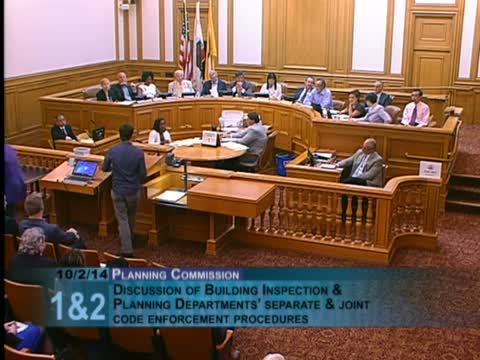
During a joint meeting on the new permit tracking system and code enforcement, commissioners and dozens of public commenters pressed city staff on whether Planning and the Department of Building Inspection (DBI) have the tools and staffing to police a wave of short‑term rental (STR) legalization and longstanding unpermitted conversions.
"Short‑term rentals is going to be a nightmare," Peter Cohen, from the Council of Community Housing Organizations, told the joint commissions. He and other speakers said rapid policy changes at the Board of Supervisors risk outpacing the city’s ability to monitor compliance at the building and neighborhood level.
Several speakers raised life‑safety and accessibility concerns if STRs are regulated as hotel‑like uses. Charlie Goss of the San Francisco Apartment Association noted a Land Use Committee amendment requiring door signage with emergency‑safety information and asked how DBI would enforce signage, posting, translation and funding for enforcement. "These are life safety issues and they're very serious," Goss said.
Planning staff described the enforcement mechanics currently under consideration for pending STR legislation: a municipal registry that would be publicly discoverable on the property‑information map, a self‑reporting requirement for hosts, and a one‑year look‑back and report to the Board of Supervisors to assess enforceability and staffing needs. Scott Sanchez, Planning’s zoning administrator, said evidence of residency could include vehicle or voter registration and that staff would evaluate complaints and follow the record of stays; he called the approach “a bit of an experiment.”
Commissioners repeatedly warned that even with a registry the city may lack the resources to monitor hundreds of thousands of housing units. Calvin Walsh and other public commenters cited estimates of thousands of units converted to illegal use and urged the commissions to demand concrete monitoring tools and funding from the Board of Supervisors. "We are being told that this should be allowed for 90 days... or 365 days if hosted," Walsh said, urging practical enforcement strategies.
Department staff acknowledged the scale of the challenge. DBI and Planning directors said the proposed effective date for the ordinance would be delayed to allow departments to stand up new enforcement infrastructure (including a hearing officer) and that fees could be adjusted to cover added enforcement costs if necessary. Staff repeatedly recommended a one‑year report back to evaluate whether new tools are sufficient.
Other public comments focused on related enforcement issues: routine conversions of industrial or PDR spaces to offices without Planning review, inconsistent permit valuation that may reduce fee recovery, and gaps in public handouts and transparency at the hearing. Several commissioners asked for targeted audits, stronger cross‑checks with the assessor’s records and ongoing joint meetings to monitor STR implementation and other systemic enforcement gaps.
The commissions did not take any formal votes at the meeting; staff were asked to refine outstanding questions that can be addressed via the new PPTS portal and return to the commissions for follow‑up.