Get Full Government Meeting Transcripts, Videos, & Alerts Forever!
Get email alerts on the Wireless Facility topic
No spam. Unsubscribe anytime.
Commission pauses decision on AT&T rooftop antennas at 1098 Jackson after strong neighborhood opposition
Summary
Planners recommended approval to add six screened antennas at 1098 Jackson, but neighbors raised RF‑emission, aesthetics and tenant‑displacement concerns; the commission moved to continue and register a motion of intent to disapprove, continuing the matter to Oct. 2 (vote 4–3).
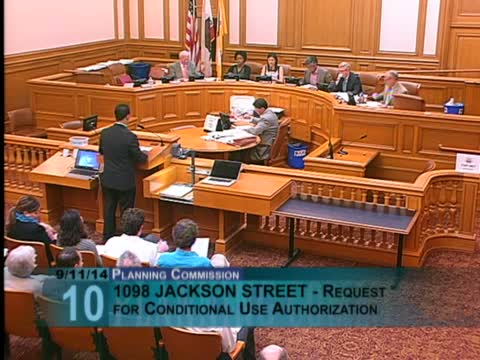
AT&T asked the Planning Commission for authorization to install a six‑panel rooftop wireless facility at 1098 Jackson Street in Nob Hill, citing capacity needs in a densely served mixed‑use block. Staff presented the carrier’s alternative‑site analysis and said the proposed design would minimize visual impacts through screening and setbacks.
More than two‑hundred members of the public contacted staff and many testified at the hearing, raising worries about radio‑frequency exposure, the facility’s visibility from public rights of way and the impact of an equipment room that would occupy basement space used by small businesses. Tenants of on‑site businesses — a dry cleaner and small cafe — told the commission they faced reduced storage and the prospect of noisy equipment adjacent to their work areas.
AT&T representatives described a 27‑site alternatives analysis and a third‑party RF study that, they said, showed exposures well below federal limits and a lack of feasible lower‑impact alternatives in the immediate area. Planning staff noted the site is a “disfavored” Tier‑7 site under city siting guidelines, which places higher scrutiny on aesthetics and alternatives.
Commissioners split along policy lines over coverage needs versus neighborhood impacts. Several members said there were reasonable questions about whether nearby, less intrusive sites had been fully exhausted; others said denial could push carriers to less visible but harder‑to‑control distributed antenna systems (DAS) on utility poles. After debate the Commission approved a motion of intent to disapprove and continued the item to an Oct. 2 hearing for further review; the motion to continue and register intent to disapprove passed 4–3.