Get Full Government Meeting Transcripts, Videos, & Alerts Forever!
Get email alerts on the Historic Preservation topic
No spam. Unsubscribe anytime.
Commission upholds Planning Department's PMND for Commonwealth Club redevelopment after heated preservation debate
Summary
The Planning Commission voted to uphold a preliminary mitigated negative declaration for the Commonwealth Club's proposed rehabilitation and addition at 110 Embarcadero, after extended public testimony from preservationists, labor groups and historians pressing to preserve the Embarcadero facade as landmark-quality. Commissioners found the Stewart Street facade is the primary historic resource and recommended design/mitigation measures and public interpretation.
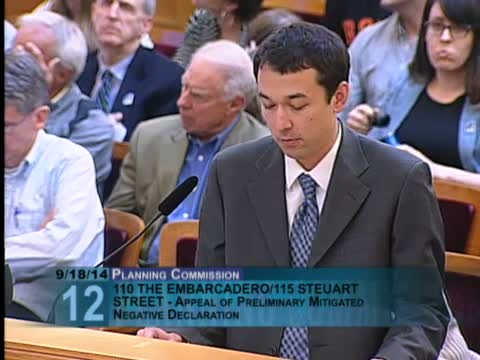
The Planning Commission voted Sept. 18 to uphold the Planning Department's determination that the Commonwealth Club's proposed project at 110 Embarcadero/115 Stewart Street would not require an Environmental Impact Report under CEQA.
The hearing featured nearly four hours of public testimony. Appellants including David Osgood, Bradley Wiedemeyer, the ILWU and local preservation groups argued the entire building, not just the Stewart Street facade, is a historic resource tied to the 1934 waterfront strike and that the club's proposed contemporary Embarcadero facade would preclude future landmark designation. "This building is historic not just its western facade," said appellant David Osgood. Labor representatives stressed the building's role as the International Longshoremen's Association hall during the 1934 strikes and urged preservation of the Embarcadero elevation.
The Commonwealth Club and its design team said the Stewart Street facade ' the location associated with the shootings and funeral procession known as "Bloody Thursday"' would be preserved and interpreted inside the building. Project architect Marsha Maynam described design choices intended to meet sustainability goals (natural ventilation, operable windows, green roof) and presented the program for a 300-seat auditorium and public library space. Club representatives said they plan displays and public programming to highlight the 1934 events.
Staff and the club presented a historic resource evaluation supporting the conclusion that Stewart Street rises to the level of an historic resource under CEQA criterion 1 (association with historic events) while the Embarcadero facade, although old and contributing, did not retain the same direct association. Commissioners asked detailed preservation questions, discussed potential mitigation (plaque, in-building exhibitions, setback revisions) and whether the project would invalidate future landmarking. Staff and the club said landmarking of the Stewart Street side would remain possible.
After deliberation, commissioners voted to uphold the PMND. Several commissioners emphasized the project's commitment to programmatic interpretation and on-site preservation of Stewart Street elements; others urged the club to consider formal landmark designation for preserved elements.
What happens next: The project will proceed to the Board of Supervisors as the next reviewing body on related entitlements and the club has said it will consider additional measures (landmarking, plaques, archival materials) to ensure long-term public access to the site's labor history.