Get Full Government Meeting Transcripts, Videos, & Alerts Forever!
Get email alerts on the Office Allocation topic
No spam. Unsubscribe anytime.
Planning commission hears widening pipeline under Prop M; staff urges policy options including competitive pool
Summary
Planning Department presented a data-heavy briefing showing a historically large pipeline of office projects and urging the Planning Commission to consider alternatives to first-come, first-served allocations under Prop M, including a competitive pool, smoothing caps, and stronger design and affordability criteria.
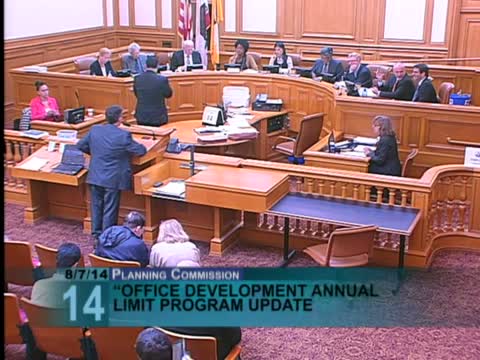
The San Francisco Planning Department told the Planning Commission on Aug. 7 that the city’s annual office limit under Proposition M is being strained by an unusually large and geographically dispersed pipeline of projects. Corey Tee, a department planner, said the system’s mechanics — 950,000 square feet a year divided into small- and large-cap allocations — have not changed, but that the volume and size of pending projects has reached levels not seen since the dot-com boom.
Tee said the department currently shows roughly 2.1 million square feet of large-cap availability with more than 2.15 million square feet pending and over 9 million square feet in pre-application, a pipeline large enough that, if all projects matured simultaneously, the city could be ‘‘9,000,000 square feet in the red’’ relative to the cap. ‘‘It is a historically large pipeline,’’ he said, noting many projects will in practice take years to mature, that some need rezoning, and that market conditions will change some proposals.
The presentation, which ran through Prop M’s history and the development-fee framework that attaches jobs‑housing linkage and transit impact costs to large projects, asked the commission whether it should move beyond a project-by-project approach. Officials sketched alternatives: a competitive-pool system that scores projects on defined criteria, a temporary artificial cap to smooth allocations across years, or a requirement that the commission adopt clearer scoring weights (for transit access, displacement risk, affordable‑housing benefit and design quality) when the city faces an allocation ‘‘bottleneck.’’
Supporters of the standing rules said the city should protect commitments already made via approved plans in Mission Bay, Hunters Point and Treasure Island. Several commissioners urged careful attention to the ‘‘three-legged stool’’ of office, housing and transit — an appeal to pair allocation decisions with specific mitigations tied to transit investments and housing production. ‘‘If we allow growth, it should be mitigated — jobs, housing and transit go together,’’ one commissioner said.
Public commenters who helped craft Prop M urged the commission to keep the program’s original aim of balancing jobs with housing and transit capacity, while others called for quicker enforcement of expired allocations and clearer rules for recapturing unused square footage when projects convert to other uses.
The presentation did not propose immediate regulatory changes, but staff said it had asked some projects to pause temporarily so the commission could consider options collectively. Commission members signaled interest in further hearings, possible data requests, and looking at pilot policies before any permanent changes. Director of Planning agreed to return with more detailed policy options if the commission requests follow‑up work.
The department emphasized that any substantive change to voter‑approved language in Prop M would require a ballot amendment, but the commission still can modify code-level implementation and create competitive or smoothing policies within existing rules.
Next steps: planning staff offered to supply more granular pipeline data and model outcomes for different allocation methods; the commission said it would schedule follow-up hearings and consider forming a subcommittee or asking staff to draft specific policy alternatives.