Get Full Government Meeting Transcripts, Videos, & Alerts Forever!
Get email alerts on the Dwelling Unit Merger topic
No spam. Unsubscribe anytime.
Commission approves merger of two small rental units into a three‑bedroom family home at 344 Third Avenue
Summary
Over staff recommendation to disapprove, the Planning Commission voted 6–1 to allow a merger of two small one‑bedroom units into a single three‑bedroom owner‑occupied home, accepting the applicants' argument about keeping a family in San Francisco.
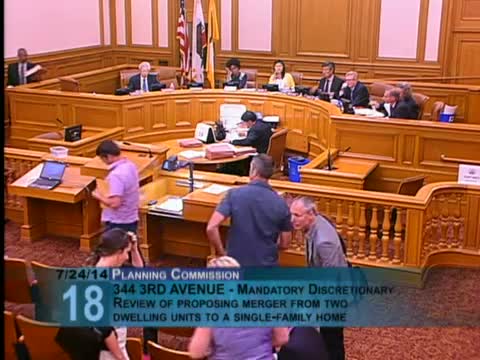
The Planning Commission on July 24 approved a request to merge two small one‑bedroom units at 344 Third Avenue into a single three‑bedroom home so an owner‑occupant family can remain in the city. Staff had recommended discretionary review and disapproval because the merger would reduce the city's housing stock by one unit and remove two small but habitable rental units in an RM‑1 zone where three units are allowed by lot area.
Applicants Jennifer Johnson and Aaron Miller told commissioners they had lived in the property for eight years, temporarily occupied both units while expecting a child and sought a modest 1,644‑square‑foot three‑bedroom family home to raise their child and stay near extended family. The applicant noted neither unit had been rented in recent years and described the merger as creating family‑sized housing rather than eliminating active rental inventory.
After discussion the commission declined to take discretionary review and voted to approve the merger by 6–1; Commissioner Wu recorded the lone no vote. Several commissioners cited the mayor's housing priorities and the practicalities of keeping families in the city as factors in their decision.
Why it matters: The vote highlights the commission's discretion in weighing preservation of small units against family housing needs, and it underscores an ongoing tension in city policy between protecting existing rental stock and enabling family‑sized ownership housing.