Get Full Government Meeting Transcripts, Videos, & Alerts Forever!
Get email alerts on the Formula Retail topic
No spam. Unsubscribe anytime.
Planning commission debates tougher, broader formula-retail rules as supervisors offer rival measure
Summary
The Planning Commission spent hours on competing proposals to tighten formula-retail controls — including which businesses count as chains, when a replacement triggers a public hearing, and whether a higher outlet threshold should let small local chains grow before regulation.
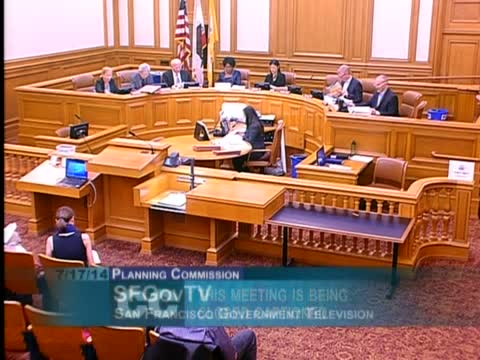
The San Francisco Planning Commission on July 17 heard more than four hours of testimony and expert analysis on proposed changes to the city's formula-retail rules, a patchwork of standards enacted after voters approved Proposition G in 2006 to protect neighborhood commercial districts from chain-store homogenization. The hearing paired a Planning Department ordinance with an alternate measure from Supervisor Eric Marr and produced a mix of staff-and-supervisor-level agreements along with unresolved gaps that will go to the Board of Supervisors.
The most disputed question was what counts as a chain: the Planning Department would raise the numerical threshold that triggers formula-retail scrutiny to 20 outlets nationwide while adding several new retail categories (personal services, limited financial services, massage and tobacco/paraphernalia) and broadening geographic scope to parts of Central Market. Marr's draft keeps the smaller threshold (the longstanding 11-outlet rule favored by many neighborhood groups) and advances subsidiary-ownership rules and other changes favored by merchants and civic coalitions. Both sides agree on stronger design and signage guidance and require more consistent analytic review when a new retail use is proposed.
The commission heard detailed economic testimony from Ted Egan, the Controller's chief economist, who described the Office of Economic Analysis's price-basket and spending-circulation work: his team found higher average prices at non-chain stores in some comparisons and evidence that locally owned retailers recirculate more dollars in the city, but also noted large gaps in data on rents, neighborhood quality and long-term housing impacts. Supervisor Marr and other public commenters cited Civic Economics and other studies that draw a different balance between price and local-recirculation effects; Marr asked the panel to preserve neighborhood discretion and called for stronger counting of subsidiary relationships.
Neighbors, small-business owners and trade groups offered sharply different views. Merchant associations, some neighborhood organizations and the Chamber of Commerce supported the Planning Department's compromise approach, arguing that modest relief for small homegrown chains (a higher outlet threshold) would permit local firms to scale up without immediately triggering an expensive discretionary process. Opponents — neighborhood coalitions, Telegraph Hill Dwellers and independent grocers — urged the commission to keep the count low, to regulate subsidiaries and to require rigorous community notice and review, warning that chain expansion contributes to higher commercial rents and the loss of neighborhood character.
After public comment, commissioners amended staff wording on several procedural points and took votes. The commission removed a staff-drafted non-severability clause (so parts of the ordinance could not be invalidated simultaneously by litigation), a change that passed 5–2. Later the commission voted 4–3 to forward Supervisor Marr's ordinance to the Board of Supervisors with a direction to study the economic-impact reporting approach and subsidiaries for six months rather than adopt an immediate, broad study requirement. Both ordinances — the Planning Department's updated code and Supervisor Marr's board file — will be considered by supervisors in coming months.
What happens next: the Board of Supervisors will take up the competing measures; staff and supervisors said they expect further stakeholder work on how to measure 'intensification' (when a change of tenant or a conversion requires a new conditional-use hearing), how to tally outlets (open vs. permitted location), and how to craft workable rules for subsidiaries. Several speakers urged the board to preserve meaningful community notice and public hearings for controversial changes; planning staff said the updated "performance-based" design guidelines will apply to formula retail in all cases.
The commission's action preserves the broad direction of tightening design and disclosure standards while leaving the most politically fraught choices'thresholds, subsidiaries and economic-report triggers'to further study and legislative deliberation.